Football in Morocco is often discussed in terms of results, tactics, or international performances. Yet, beyond what happens on the pitch, there is another dimension that gives Moroccan football much of its meaning: the stadium itself. In a previous article, we explored how football functions as a pillar of national identity in Morocco. This identity, however, does not exist only in abstract narratives or symbolic discourse. It is lived, expressed, and reinforced in very concrete spaces.
This article builds on that reflection by focusing on one central question: how does stadium atmosphere contribute to shaping and expressing Moroccan football identity? Rather than offering a romanticized view, the aim is to understand how collective presence, shared rituals, and emotional intensity turn stadiums into powerful social spaces.
For the broader context, read our pillar article: Football and National Identity in Morocco.
Stadiums as Social Spaces in Morocco
In Morocco, football stadiums are more than sporting venues. On match days, they become places where social boundaries temporarily blur. Supporters from different backgrounds, generations, and regions gather around a shared experience. The stadium functions as a meeting point where everyday differences give way to collective belonging.
This social dimension helps explain why football occupies such a central place in public life. Attending a match is not simply about watching a team play; it is about participating in a collective moment. The stadium offers a space where emotions can be expressed openly, where voices merge, and where individual identities momentarily align with a broader national narrative.
Supporters, Chants, and Collective Expression
Chants and Oral Traditions
One of the most striking elements of stadium atmosphere in Morocco is the role of chants. These chants are rarely spontaneous. They are learned, repeated, and passed on, often across generations. In this sense, they function as a form of oral tradition.
Through rhythm and repetition, chants create continuity. They recall past matches, shared memories, and collective emotions. Even for newcomers, joining in is a way of entering a shared cultural code. The act of chanting together reinforces a sense of unity that goes beyond the match itself.
Visual Symbols and National Colors
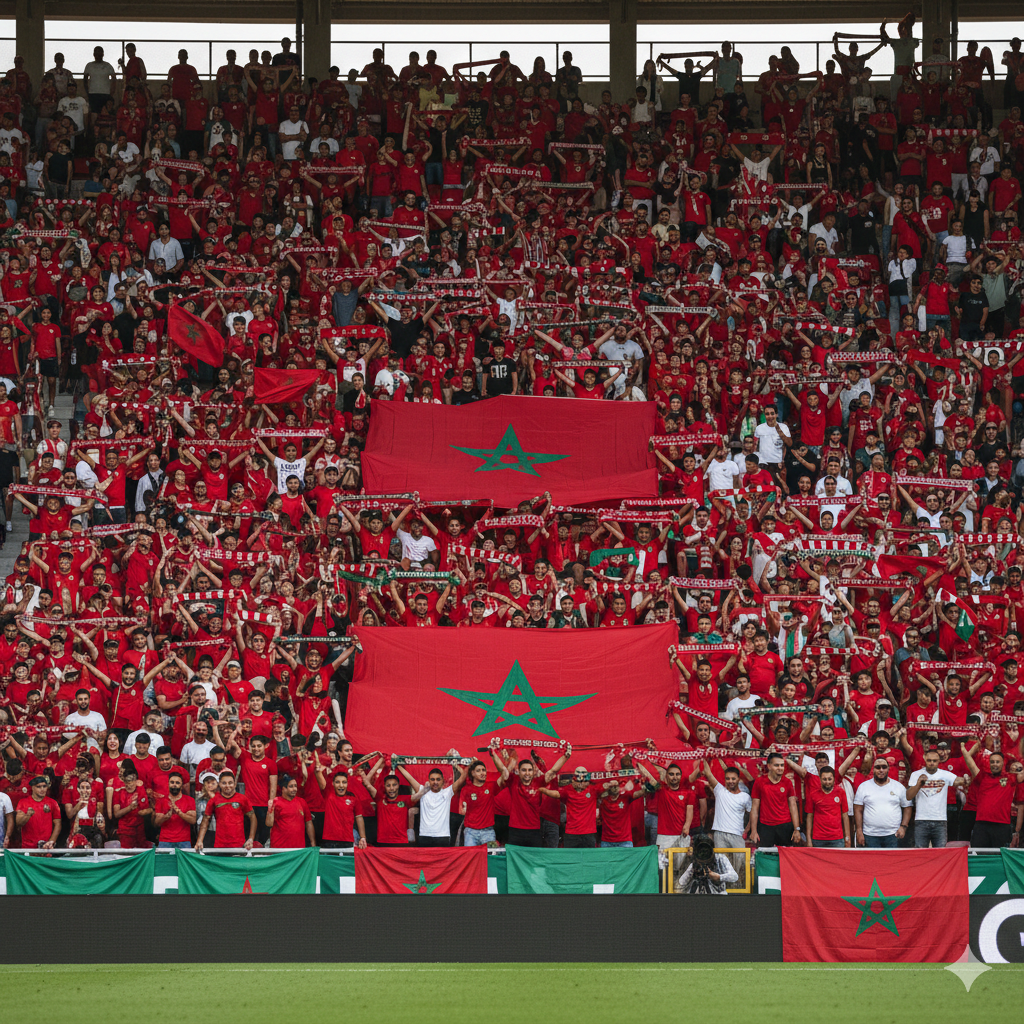
Visual expression plays an equally important role. Flags, scarves, and national colors are omnipresent in Moroccan stadiums. These symbols transform the stands into visual representations of collective identity.
What matters here is not aesthetic display alone, but meaning. The repetition of colors and symbols helps construct a shared visual language. It makes identity visible, tangible, and immediately recognizable. In this way, the stadium becomes a space where national identity is not only felt, but also seen.
From Local Stadiums to National Representation
While football culture often develops at the club level, its symbolic reach extends far beyond local rivalries. Stadium practices—chants, gestures, visual codes—frequently migrate from club football to matches involving the national team.
This movement illustrates how local experiences contribute to national representation. Stadiums act as laboratories of identity, where expressions developed in one context can be reused and reinterpreted in another. When the national team plays, supporters do not invent a new identity; they adapt practices already rooted in club culture.
Stadium Atmosphere as a Mirror of Moroccan Football Identity
Rather than creating identity from scratch, stadium atmosphere reflects and amplifies existing social and cultural dynamics. The emotions expressed in the stands echo broader feelings of belonging, pride, and collective memory.
In this sense, stadiums do not generate Moroccan football identity on their own. They function as mirrors—spaces where identity becomes visible through shared experience. This observation reinforces the idea developed in the article on football and national identity: football matters not only because it is played, but because it is lived together.
If you want to go further, you may also like: What Makes Moroccan Football Unique in Africa?
Répondre à Supporters, Stadiums, and Collective Identity in African Football – Morocco Football Tribune Annuler la réponse