⚡ 30-Second Summary
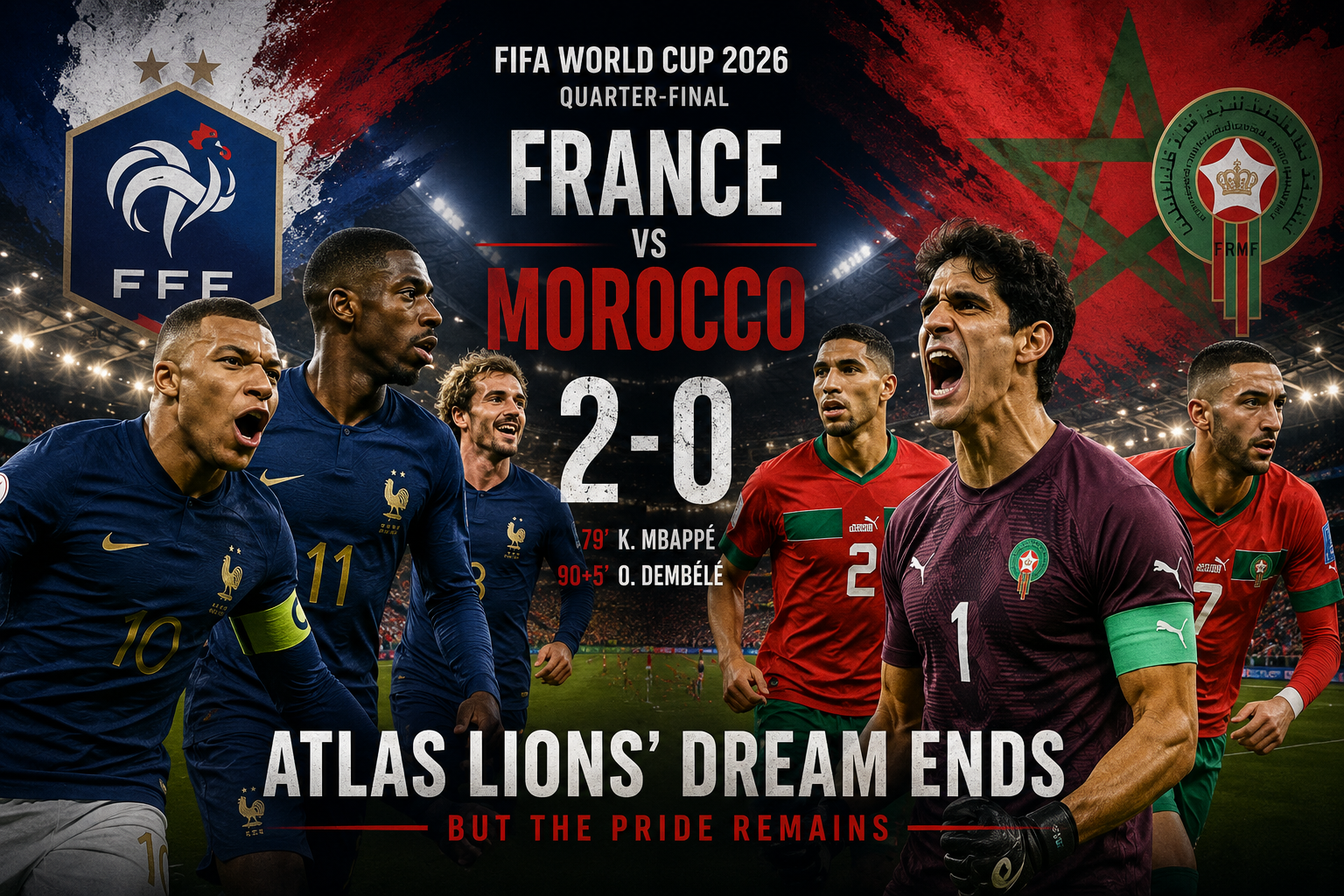
Morocco’s FIFA World Cup 2026 campaign ended in the quarter-finals after a 2–0 defeat against France at Boston Stadium.
Yassine Bounou saved a first-half penalty from Kylian Mbappé, but France’s pressure eventually told after the break. Mbappé opened the scoring in the 60th minute before Ousmane Dembélé doubled the lead six minutes later.
The Atlas Lions showed discipline and resilience, but they struggled to create clear chances against an aggressive French press and recorded only one shot on target.
🧠 Think You Remember Everything?
Read the full match report first, then test your knowledge with our interactive quiz at the end of the article.
Morocco’s World Cup dream ended not with a collapse, but with a reminder of how unforgiving elite knockout football can be.
For nearly an hour, the Atlas Lions resisted France. Yassine Bounou saved a penalty. The defensive block absorbed wave after wave of pressure. The score remained level, and hope remained alive.
Then the match changed in six brutal minutes.
Kylian Mbappé found the opening goal on the hour. Ousmane Dembélé struck again in the 66th minute. France had finally converted their dominance, and Morocco could not find a route back into the quarter-final.
The final score, France 2–0 Morocco, ended another proud World Cup journey for the Atlas Lions and sent France into the semi-finals. France’s victory was built on persistent pressure, greater attacking depth and decisive efficiency when the spaces finally appeared.
Morocco leave the tournament disappointed, but not diminished. To understand how the Atlas Lions reached this stage, revisit our complete review of Morocco’s journey to the FIFA World Cup 2026 knockout stage. They eliminated the Netherlands, defeated Canada 3–0 and once again proved that reaching the knockout stages of a World Cup is no longer an extraordinary accident. It is becoming an expectation.
✔ MFT Fact Check
- ✔ Competition: FIFA World Cup 2026
- ✔ Stage: Quarter-final
- ✔ Date: 9 July 2026
- ✔ Venue: Boston Stadium, Foxborough, Massachusetts
- ✔ Final Score: France 2–0 Morocco
- ✔ Goals: Kylian Mbappé 60’, Ousmane Dembélé 66’
- ✔ Yassine Bounou saved a penalty from Mbappé in the 28th minute
- ✔ France qualified for the semi-finals
- ✔ Morocco were eliminated from the tournament
🔵 Match Snapshot
| Category | Information |
|---|---|
| Competition | FIFA World Cup 2026 |
| Stage | Quarter-final |
| Fixture | France vs Morocco |
| Final Score | France 2–0 Morocco |
| Venue | Boston Stadium |
| France Goals | Kylian Mbappé 60’, Ousmane Dembélé 66’ |
| Morocco Highlight | Yassine Bounou penalty save, 28’ |
| Outcome | France advance to the semi-finals |
A First Half Built on Moroccan Resistance
France began with intensity.
Their pressing made Morocco’s build-up uncomfortable from the opening minutes. The Atlas Lions attempted to remain compact, protect central areas and use Brahim Diaz as a lone forward, but France recovered the ball quickly and repeatedly forced Morocco backwards.
Kylian Mbappé produced the first major warning with a low effort that Bounou pushed away. The Moroccan goalkeeper would soon become the central figure of the first half.
In the 28th minute, France were awarded a penalty.
Mbappé stepped forward with the opportunity to break Moroccan resistance. Bounou remained patient, read the direction correctly and stopped the low attempt.
It was a huge moment.
For Morocco, the save represented more than a defensive action. Bounou had already been decisive earlier in the tournament, particularly during the dramatic victory over the Netherlands in the Round of 16. It gave the team belief. France had created the clearest chance of the match, yet the score remained 0–0.
Bounou’s intervention kept the Atlas Lions alive, but it did not change the overall direction of the game. France continued to circulate the ball and search for openings, while Morocco struggled to escape their own half.
In first-half stoppage time, Lucas Digne came close to opening the scoring when his long-range effort struck the crossbar. Morocco reached the interval without registering a shot, but they remained level thanks to defensive discipline, French wastefulness and Bounou’s composure.
Mbappé Breaks the Deadlock
Morocco’s plan had succeeded for 59 minutes.
The problem was that defending without sustained attacking relief demanded enormous physical and mental energy.
France kept pressing. Morocco kept running. The space between the Moroccan midfield and defence began to grow.
In the 60th minute, Mbappé finally found the breakthrough.
The French captain created enough separation inside the area and curled his finish beyond Bounou. After missing from the penalty spot, Mbappé responded with the quality expected from one of the tournament’s defining players.
It was his eighth goal of the competition and his 20th World Cup goal.
The timing was devastating for Morocco.
The Atlas Lions had spent almost an hour protecting the scoreline. Once they fell behind, they needed to change the rhythm, take more risks and push players forward.
France punished that adjustment almost immediately.
Six Minutes That Ended the Dream
In the 66th minute, Ousmane Dembélé made it 2–0.
Mbappé’s movement opened the space, and Dembélé attacked it with precision before driving a low finish into the net.
France had scored twice in six minutes.
Morocco suddenly faced the most difficult possible scenario: two goals behind against a team that had controlled territory, created the better chances and kept its defensive structure intact.
The Atlas Lions tried to respond, but France’s pressing continued to restrict the available passing options.
Morocco did not register a shot on target until the 84th minute. By then, France were managing the match rather than chasing it.
The final whistle confirmed the end of Morocco’s campaign.
⏱️ Match Timeline
France and Morocco begin their FIFA World Cup 2026 quarter-final at Boston Stadium.
Morocco’s goalkeeper reads the French captain’s low effort and keeps the score level.
Lucas Digne’s powerful long-range effort strikes the frame of the goal.
Morocco survive intense French pressure and remain in the contest.
Kylian Mbappé curls France into the lead.
Ousmane Dembélé doubles the advantage six minutes later.
The Atlas Lions finally test the French goal, but the deficit remains unchanged.
France advance to the FIFA World Cup 2026 semi-finals. Morocco’s tournament ends in the last eight.
The Turning Point
The obvious turning point was Mbappé’s goal in the 60th minute.
But the deeper turning point came earlier.
Morocco were unable to transform Bounou’s penalty save into attacking momentum.
A saved penalty can change the emotional balance of a knockout match. It can create doubt in the attacking team and confidence in the defending side.
France, however, did not panic.
They continued to press, continued to move the ball and continued to force Morocco into defensive actions. France coach Didier Deschamps later explained that his team never doubted it would find the breakthrough despite the missed penalty and wasted first-half opportunities.
Morocco survived the incident but could not use it to push the match in a new direction.
That distinction proved decisive.
Why Morocco Struggled to Create Chances
Morocco’s main difficulty was not possession itself.
The Atlas Lions had 52% of the ball, slightly more than France’s 48%. But possession did not translate into territorial control or attacking threat.
France completed its actions at a higher tempo and pressed aggressively after losing the ball. Morocco often circulated possession in safer areas without finding passes that eliminated French defenders.
The statistics reveal the imbalance:
- France attempted 22 shots.
- Morocco attempted five.
- France recorded nine shots on target.
- Morocco recorded one.
- France created 19 chances.
- Morocco created three.
- France generated 2.96 expected goals.
- Morocco generated 0.31.
Morocco were also missing injured forward Ismael Saibari, whose movement, physical presence and direct attacking threat had played an important role earlier in the tournament.
Without him, Brahim Diaz operated as the lone striker. He worked hard, but France’s centre-backs prevented him from receiving consistently in dangerous positions.
The Atlas Lions needed more depth behind the French defensive line and more runners arriving around Diaz.
They rarely found either.
📊 Match Statistics
| Statistic | France | Morocco |
|---|---|---|
| Goals | 2 | 0 |
| Possession | 48% | 52% |
| Total Shots | 22 | 5 |
| Shots on Target | 9 | 1 |
| Expected Goals | 2.96 | 0.31 |
| Chances Created | 19 | 3 |
| Passing Accuracy | 92% | 89% |
| Corners | 5 | 5 |
| Goalkeeper Saves | 1 | 7 |
Yassine Bounou: Morocco’s Standout Performer
Morocco’s strongest individual performance came from Yassine Bounou.
The scoreline could have become more severe without him.
He saved Mbappé’s penalty, stopped seven shots and repeatedly gave Morocco a chance to remain in the match. His positioning was calm, his reactions were sharp and his decision-making reflected the experience of a goalkeeper accustomed to major tournament pressure.
Bounou could not prevent the two second-half goals, but he was not responsible for Morocco’s defeat.
He delayed it.
⭐ MFT Morocco Player of the Match
Yassine Bounou
Bounou saved a first-half penalty from Kylian Mbappé and made seven saves in total. His performance kept Morocco level until the 60th minute and prevented France from building a larger advantage.
France’s Pressing Made the Difference
France’s victory was not based only on individual brilliance.
The tactical foundation was their pressing.
Whenever Morocco attempted to build from the back, the French attacking line closed the central options and encouraged passes toward the touchline. Once the ball moved wide, France accelerated the pressure and limited Morocco’s ability to progress.
The Atlas Lions completed many passes but too few of them moved the team into dangerous areas.
France’s pressure also forced Morocco to spend energy without the ball. By the second half, the spaces France had been searching for began to appear.
Deschamps described the strategy clearly after the match: France pinned Morocco back, forced the Atlas Lions to run and gradually exhausted them.
That explains why the two goals arrived so close together.
The first damaged Morocco’s structure.
The second punished it before it could recover.
🧠 MFT Insight
Morocco’s possession figure suggests an even contest, but the quality of possession tells a different story. France allowed the Atlas Lions to circulate the ball in areas that posed limited danger, then applied intense pressure whenever Morocco attempted to progress through midfield.
The match was not decided by who had the ball more often. It was decided by who controlled where the ball could go.
What This Result Means for Morocco
This defeat will hurt.
Morocco had already shown that they could survive a penalty shootout against the Netherlands and dominate decisive moments against Canada.
The possibility of another World Cup semi-final felt real.
France ended that possibility, but the quarter-final exit should not erase the broader achievement.
Morocco reached the last eight of a 48-team World Cup. They eliminated the Netherlands. They defeated Canada 3–0. Morocco’s journey to the quarter-finals was built on several disciplined performances. Read our complete analysis of How Morocco Qualified for the FIFA World Cup 2026 Knockout Stage. They competed against France while carrying the pressure of a nation that now expects success.
That expectation is itself evidence of progress.
In previous eras, reaching the quarter-finals would have been celebrated without reservation.
Now, elimination at that stage creates disappointment.
That is not a sign of failure.
It is a sign that Moroccan football has entered a different level of ambition.
Morocco coach Mohamed Ouahbi acknowledged that France were the stronger team and created the better chances, while also insisting that Morocco remain capable of progressing and competing with the world’s best.
The next challenge is to convert that ambition into greater squad depth, more attacking solutions and a team capable of controlling matches against elite opponents rather than only surviving them.
The End of a Journey, Not the End of a Project
Morocco’s 2026 World Cup campaign is over.
The project is not.
The Atlas Lions will leave North America with both pride and unanswered questions.
How can Morocco create more chances against elite pressing teams?
How can the attack remain dangerous when key players are unavailable?
How can the team turn defensive resilience into sustained attacking control?
Those questions will shape the next phase.
Morocco will co-host the 2030 World Cup with Spain and Portugal. The experience gained in 2026 will therefore carry meaning beyond this tournament.
The objective can no longer be simply to participate.
It must be to arrive in 2030 with a team deep enough, flexible enough and fearless enough to challenge for the title.
💡 Did You Know?
France have now eliminated Morocco from two consecutive FIFA World Cups: the 2022 semi-final and the 2026 quarter-final. Both matches ended 2–0.
❓ Frequently Asked Questions
What was the final score between France and Morocco?
France defeated Morocco 2–0 in the FIFA World Cup 2026 quarter-finals.
Who scored for France against Morocco?
Kylian Mbappé scored in the 60th minute, and Ousmane Dembélé added the second goal in the 66th minute.
Did Yassine Bounou save a penalty?
Yes. Bounou saved Kylian Mbappé’s penalty in the 28th minute and made seven saves during the match.
How many shots did Morocco have?
Morocco attempted five shots and registered one effort on target.
Is Morocco eliminated from the FIFA World Cup 2026?
Yes. The defeat ended Morocco’s tournament in the quarter-finals, while France advanced to the semi-finals.
Who was Morocco’s best player against France?
Morocco Football Tribune selected Yassine Bounou as Morocco’s Player of the Match after his penalty save and seven saves overall.
🧠 Test Your Knowledge
How closely did you follow France vs Morocco? Answer the five questions below and discover your score instantly.
📚 Continue Reading
Continue exploring Morocco’s FIFA World Cup 2026 journey with our latest coverage.
Morocco vs Canada Match Report →
Five Secret Weapons Morocco Used on Their Road to the Quarter-finals →
📣 Join the Conversation
What was the decisive factor in Morocco’s defeat against France?
- France’s pressing
- Morocco’s lack of attacking threat
- The six-minute spell that produced two goals
- The absence of Ismael Saibari
- France’s individual quality
Who was Morocco’s best player of the tournament?
Share your opinion in the comments and continue following Morocco Football Tribune for our complete World Cup 2026 review.
Sources used for factual verification: FIFA, Reuters and FOX Sports.
Leave a Reply