
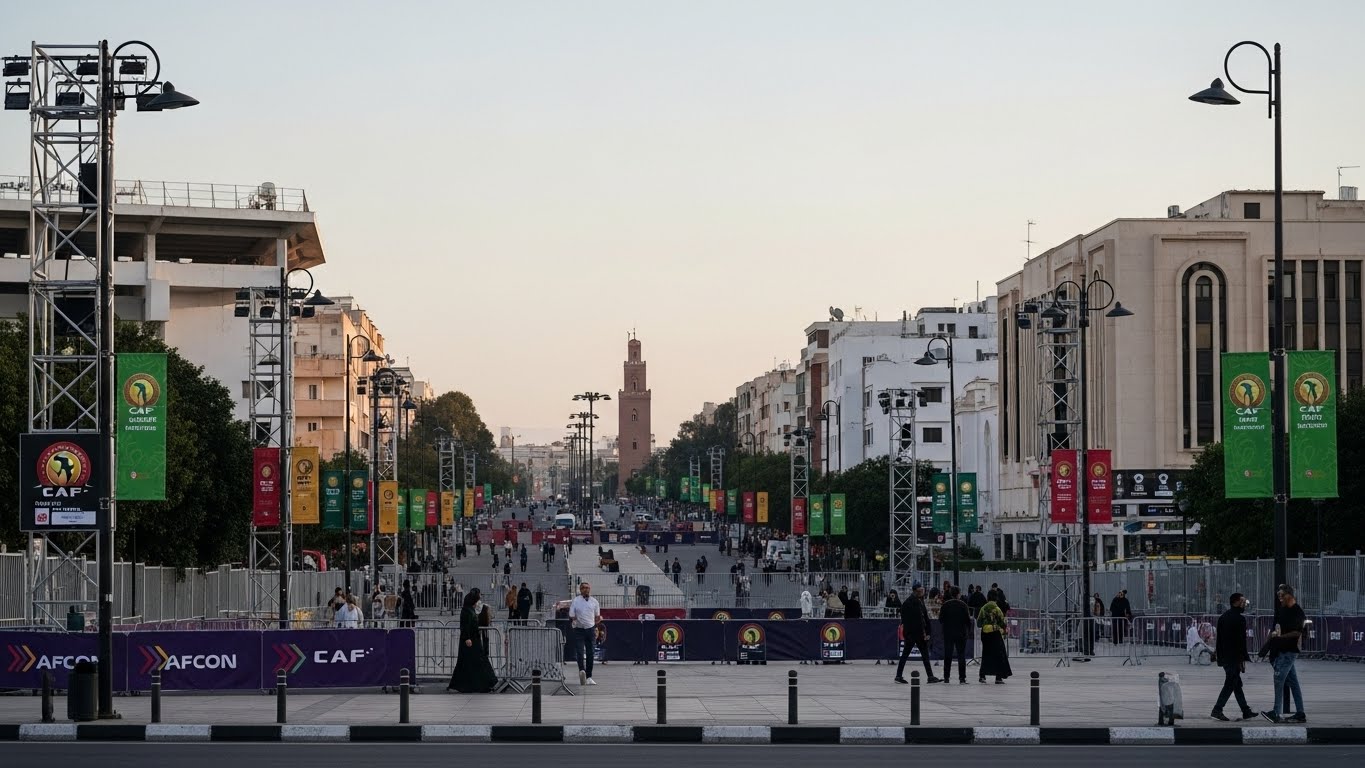
As Africa Cup of Nations 2025 unfolds in Morocco, the role of host nation extends far beyond stadiums and matchday operations. The tournament gradually reshapes public space, daily routines, and national visibility. Hosting becomes a shared experience that reaches into cities, infrastructure, and collective perception, transforming the competition into a national framework rather than a purely sporting event.
This broader exposure builds on earlier reflections about pressure and visibility during the tournament.
Hosting as a National Environment
When a country hosts a continental tournament, the event does not remain confined to designated venues. Streets, transport systems, public services, and urban rhythms become part of the tournament’s environment. The host nation is no longer represented only by its team or its stadiums, but by how everyday life absorbs and accommodates the competition.
At this stage of AFCON 2025, hosting functions as a continuous presence. Visibility increases across multiple layers of public space, and the distinction between sporting event and national setting becomes increasingly blurred.
Cities Under Continental Attention
Beyond the organizational dimension of hosting, cities emerge as visible actors in how the tournament is experienced.
Host cities occupy a central role in shaping how the tournament is perceived. Beyond infrastructure and organization, they act as interfaces between the event and the population. Public order, mobility, signage, and spatial coherence contribute to an overall impression that extends well beyond football performance.
AFCON 2025 reveals how cities are not passive backdrops but active components of hosting. Their capacity to maintain balance under sustained attention influences how the host nation is evaluated on a continental scale.
Everyday Life and Collective Exposure
Unlike isolated sporting events, a continental tournament introduces prolonged exposure. For the host nation, this means that ordinary routines coexist with exceptional visibility. Public behavior, institutional presence, and social rhythms become part of the tournament’s narrative, even when football is not directly involved.
In this context, hosting operates as a form of collective exposure rather than celebration. The challenge lies in preserving continuity while absorbing the demands of the event without disruption or overstatement.
AFCON 2025 highlights hosting as a national experience that extends well beyond the stadium. The tournament reshapes public space and collective perception, positioning the host nation under continuous observation. At this point, the significance of hosting lies not only in organization or results, but in how a country integrates the competition into its everyday environment with stability and restraint.
More articles examining the tournament are available in AFCON 2025 – Live Analysis.
Répondre à AFCON 2025: Beyond the Tournament, Toward Continuity – Morocco Football Tribune Annuler la réponse