
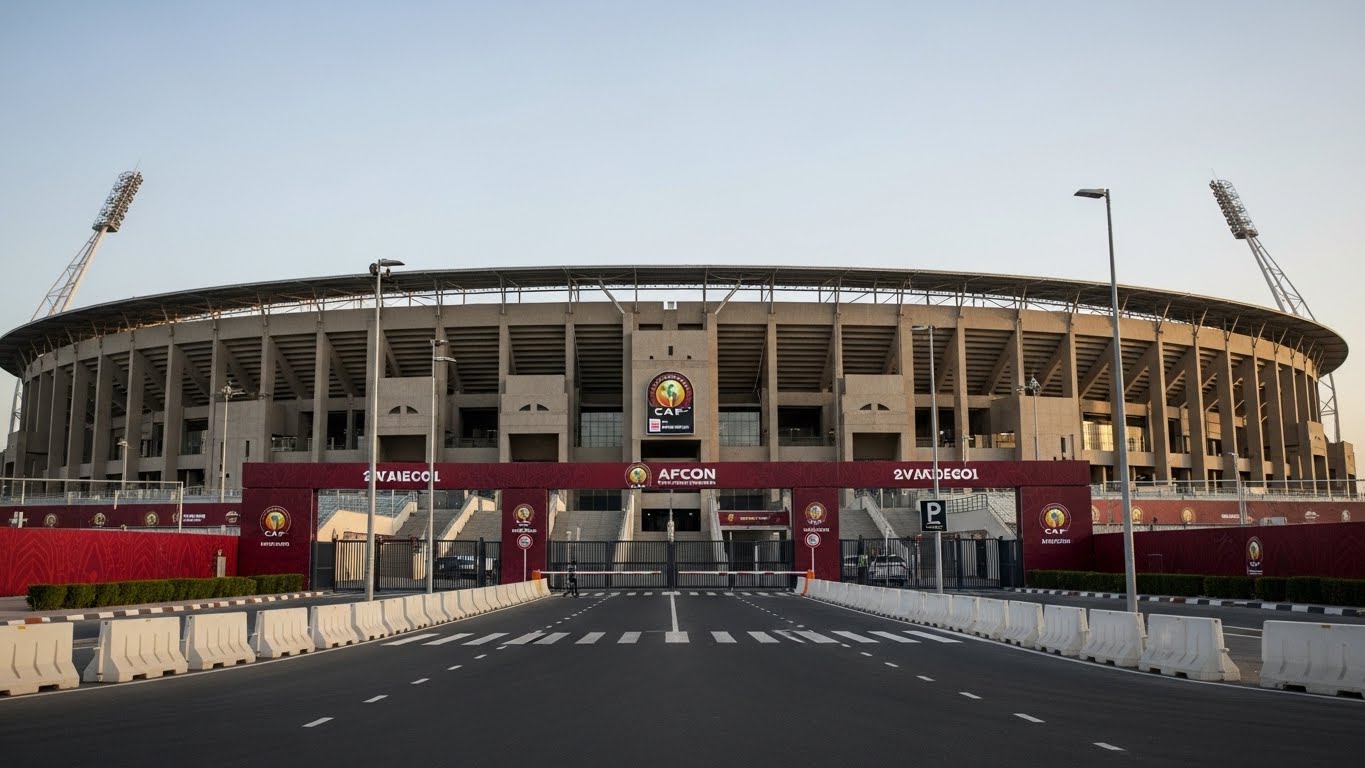
As Africa Cup of Nations 2025 unfolds across Morocco, the role of host nation extends beyond sporting considerations. Hosting is not only a matter of stadiums or schedules, but a continuous organizational process exposed to continental visibility. AFCON 2025 is progressively revealing how infrastructure, coordination, and institutional readiness shape the tournament experience as much as what happens on the pitch.
This organizational dimension complements our earlier focus on pressure management as a central dynamic.
Hosting Beyond the Stadium
The organization of a continental tournament operates on multiple layers. Stadiums are only the most visible component of a much broader system that includes transportation, access control, logistical flow, and spatial management. These elements function largely outside the spotlight, yet their efficiency directly influences the stability of the competition environment.
At this stage of AFCON 2025, hosting appears less as a fixed asset than as an ongoing process. Organization is not judged in isolation, but through its ability to remain consistent under sustained attention. Small disruptions, delays, or coordination gaps tend to gain disproportionate visibility when the host nation occupies the center of the tournament narrative.
Infrastructure as a Form of Exposure
Infrastructure is often discussed as a sign of readiness. During the tournament, however, it becomes a form of exposure. Transport routes, stadium access points, and operational layouts are not merely functional; they are continuously observed and interpreted. Their performance contributes to the perception of control, professionalism, and institutional coherence.
AFCON 2025 illustrates how infrastructure does not reduce pressure but redistributes it. The host nation is not only expected to provide facilities, but to ensure that these structures absorb pressure rather than transmit it. In this sense, organization becomes a silent actor in the competition.
Coordination Under Continental Scrutiny
Beyond physical structures, hosting relies on coordination between multiple actors: local authorities, event organizers, security services, and operational teams. The tournament environment tests how these layers interact when routines are replaced by heightened demands.
At this point, AFCON 2025 is not producing definitive judgments on organizational success or failure. Instead, it is revealing how coordination functions under real-time constraints. Continuity, adaptability, and procedural clarity emerge as more decisive than spectacle or scale.
More articles in this series are available in AFCON 2025 – Live Analysis..
AFCON 2025 positions hosting as an organizational test rather than a symbolic achievement. The tournament highlights how infrastructure and coordination operate under exposure, transforming logistics into a central dimension of the host nation’s experience. As the competition progresses, organization remains a quiet but decisive framework through which pressure is managed and credibility is sustained.
Répondre à AFCON 2025: The Host Nation Beyond the Stadium – Morocco Football Tribune Annuler la réponse