⚡ 30-Second Summary
Morocco belongs among world football’s elite because its success is no longer based on one historic tournament. After reaching the semi-finals in 2022, the Atlas Lions returned to the knockout stages in 2026, eliminated the Netherlands, defeated Canada 3–0 and reached another World Cup quarter-final.
The campaign confirmed Morocco’s tactical maturity, mental resilience, competitive depth and growing international authority. However, becoming a permanent title contender will require more attacking variety, stronger resistance against elite pressing and careful renewal before the 2030 World Cup.
🧠 How Well Do You Understand Morocco’s Rise?
Read the complete analysis, explore the evidence behind Morocco’s new global status, then test your knowledge with our interactive quiz near the end of the article.
✔ MFT Fact Check
- Morocco reached the FIFA World Cup semi-finals in 2022.
- The Atlas Lions qualified for the 2026 knockout phase from Group C.
- Morocco eliminated the Netherlands after a 1–1 draw and a 3–2 penalty shootout victory.
- Morocco defeated Canada 3–0 in the Round of 16.
- France eliminated Morocco 2–0 in the quarter-finals.
- Morocco became the first African nation to reach consecutive World Cup quarter-finals.
- Morocco, Spain and Portugal will co-host the FIFA World Cup 2030.
Morocco belongs among world football’s elite.
That statement would once have sounded ambitious, emotional or premature. After the FIFA World Cup 2026, it increasingly looks like a conclusion supported by repeated evidence.
The Atlas Lions did not win the tournament. They did not equal their historic semi-final appearance from Qatar 2022. Their campaign ended with a 2–0 quarter-final defeat against France.
Yet evaluating Morocco only through that final result would miss the larger transformation.
In 2022, Morocco broke a continental barrier by becoming the first African nation to reach a World Cup semi-final. Four years later, they returned to the knockout rounds, survived a high-pressure tie against the Netherlands, defeated Canada convincingly and reached the last eight again.
Reuters described Morocco as the first African side to reach consecutive World Cup quarter-finals, while FIFA’s tournament records confirm their route through the Netherlands, Canada and France.
One deep run can be called extraordinary.
Two consecutive deep runs begin to look structural.
The real question is therefore not whether Morocco enjoyed another successful tournament. It is what repeated success says about the country’s position inside the global hierarchy.
🏆 Morocco at World Cup 2026
What Does Belonging Among the Elite Actually Mean?
The phrase “world football’s elite” is often used too casually.
It should not refer only to famous players, passionate supporters or one memorable performance. Elite international teams are identified by what they can reproduce over time.
They qualify consistently.
They survive difficult matches.
They compete under different tactical conditions.
They manage expectations.
They recover after setbacks.
Most importantly, opponents prepare for them with respect rather than assumption.
Morocco increasingly meets those criteria.
The Atlas Lions are not yet at the level of nations that reach semi-finals and finals across several consecutive competitions. France, Argentina, Spain and other historically dominant teams possess deeper traditions of sustained success.
But Morocco has moved into the group immediately below them—and is challenging to move higher.
The country’s global status is now built on more than sentiment. It rests on results, player development, tactical credibility and an institutional project extending toward 2030.
This is why saying that Morocco belongs among world football’s elite is not the same as saying Morocco has completed its development.
Belonging is not the final destination.
It is the level from which the next challenge begins.
Morocco Is No Longer Defined by One Tournament
Qatar 2022 changed the story of African football.
Morocco topped a difficult group, defeated Spain and Portugal, and reached the semi-finals before losing to France. No African nation had previously travelled that far at a men’s World Cup.
The achievement was historic—but history can sometimes become a burden.
After an exceptional tournament, every later result is judged against the emotional height of the breakthrough. A failure to repeat the exact achievement may be interpreted as regression, even when the broader evidence indicates progress.
World Cup 2026 provided Morocco with a different test.
Could the Atlas Lions remain competitive after opponents had studied their strengths?
Could they cope with greater public expectation?
Could they progress without being treated as an unknown outsider?
Could they survive the enlarged tournament’s longer knockout route?
Their quarter-final run answered those questions positively.
FIFA’s review of Morocco’s route noted that the team finished second in Group C before overcoming the Netherlands and Canada.
The campaign did not copy 2022.
That is precisely why it mattered.
Morocco progressed through different circumstances, under different pressure and with a different coaching context. Repetition without imitation is powerful evidence of a football system becoming more stable.
Readers can revisit the complete progression in our analysis of how Morocco qualified for the FIFA World Cup 2026 knockout stage.
The Atlas Lions Understand Knockout Football
Knockout football is not merely a more intense form of league football.
It requires emotional control, risk management, tactical flexibility and an ability to survive periods when the game stops following the preferred plan.
Morocco demonstrated these qualities repeatedly.
Against the Netherlands, the Atlas Lions conceded first but remained composed. The match ended 1–1 before Morocco advanced 3–2 in the penalty shootout.
That result required more than defensive organisation. It demanded recovery after adversity and precision when every penalty carried the weight of elimination.
Our Morocco vs Netherlands match report explores how the Atlas Lions survived that psychological test.
Against Canada, Morocco faced a different challenge.
They were expected to win.
Expectation can be as difficult as fear, particularly for a team transitioning from underdog to contender. Morocco responded with a controlled 3–0 victory, demonstrating that it could impose superiority rather than merely resist it. Reuters described the performance as clinical, while FIFA’s official records confirmed Morocco’s passage into the quarter-finals.
The complete story is available in our Morocco vs Canada match report.
Against France, Morocco encountered the highest level of the tournament.
The Atlas Lions resisted for nearly an hour. Yassine Bounou saved Kylian Mbappé’s penalty, but France maintained its pressure and scored twice in six second-half minutes.
France were the better team. Morocco’s coach Mohamed Ouahbi publicly accepted that assessment while emphasising the need for honest self-criticism and continued development.
That defeat did not erase Morocco’s knockout credentials.
It clarified the next standard they must reach.
Our France vs Morocco match report examines the decisive moments behind the quarter-final elimination.
Morocco Has Built a Recognisable Competitive Identity
Elite national teams are recognisable even when personnel or formations change.
They possess habits that survive individual matches.
Morocco’s identity rests on five connected qualities.
Defensive responsibility
Moroccan players understand the collective importance of reducing space, protecting central areas and supporting teammates.
Defending is not treated as the responsibility of the back line alone.
Emotional resilience
The Atlas Lions rarely appear psychologically defeated when a match becomes difficult.
They can absorb pressure, recover after conceding and remain connected to the contest.
Tactical discipline
Morocco’s shape generally reflects a clear plan.
Players understand their zones, pressing responsibilities and transition roles.
Technical quality
The squad is no longer built only around physical commitment and defensive intensity.
Morocco possesses midfielders and attackers comfortable receiving in tight spaces, progressing possession and creating individual advantages.
National commitment
Players drawn from Morocco and the diaspora have created a shared competitive identity.
Different football educations have been integrated into one national project.
This combination makes Morocco difficult to play against.
It also explains why their success has become repeatable.
Our earlier analysis of Morocco’s tactical approach in African football examines how discipline and adaptation became central to the Atlas Lions’ modern identity.
🌍 From Underdog to Global Contender
How Morocco’s international status changed across two World Cups
Morocco possessed talent and history, but a deep World Cup run remained an ambition rather than an established expectation.
The Atlas Lions became the first African nation to reach a World Cup semi-final and changed global perceptions.
Another quarter-final run showed that Morocco’s progress was repeatable rather than dependent on one extraordinary tournament.
Respect Has Replaced Surprise
One of the clearest signs of Morocco’s new status is visible before matches begin.
Major opponents no longer speak about the Atlas Lions as an interesting outsider.
They speak about danger.
Before the 2026 quarter-final, Reuters described Morocco as France’s first major test of the tournament and examined the depth of talent, organisation and belief behind the team.
That shift in perception has tactical consequences.
Opponents prepare more carefully.
They study Morocco’s build-up patterns.
They protect against transitions.
They avoid leaving space for attacking full-backs.
They understand the psychological strength of the team.
Respect therefore makes future success more difficult.
Morocco can no longer depend on opponents being surprised by its intensity or structure. The Atlas Lions must continue evolving because the world is already adjusting to them.
That is the hidden cost of joining the elite.
The reward is recognition.
The cost is that every victory must be earned against teams prepared for Morocco’s best qualities.
The Rise Is Bigger Than the Senior National Team
Morocco’s progress cannot be explained only by the talent available to the senior coach.
The national team is the most visible expression of a broader football strategy.
Investment in training centres, youth development, facilities, scouting and international recruitment has created stronger conditions around the team.
Reuters has linked Morocco’s growing football influence to long-term investment and an increasingly ambitious national sporting project.
The Mohammed VI Football Academy has become one of the symbols of that strategy, but the larger point concerns connectivity.
A national football project becomes sustainable when academies, clubs, youth selections, data departments, coaches and senior-team planning reinforce one another.
Morocco’s access to a wide diaspora is also important.
Many players develop in demanding European environments before choosing to represent the Atlas Lions. Their different technical and tactical educations can enrich the national team.
However, recruitment is only the beginning.
The challenge is turning diverse player backgrounds into a coherent style.
Our article on how Moroccan players are shaping modern African football explores the influence of this internationally developed generation.
Morocco Has Become an African Benchmark
Morocco’s success carries continental meaning.
African football has always produced extraordinary players and memorable national teams. What has often been missing is repeated progression into the final stages of the World Cup.
Morocco’s 2022 semi-final broke one barrier.
The 2026 quarter-final showed that the breakthrough could be followed by another deep run.
Reuters concluded that African football could assess the 2026 tournament positively despite not producing a semi-finalist, with Morocco again among the continent’s strongest performers.
The Atlas Lions now represent a reference point for other African federations.
Not a model to copy mechanically, because every country has different resources and football cultures, but evidence that sustained international progress requires several elements working together:
- long-term investment;
- elite coaching;
- stronger academies;
- diaspora engagement;
- tactical education;
- institutional ambition;
- infrastructure linked to player development.
Morocco’s position also increases responsibility.
The country must prove that global success and African success can coexist.
World Cup recognition will feel incomplete without greater consistency in continental competition. Morocco’s only men’s AFCON title came in 1976, and expectations surrounding future African tournaments will remain intense.
Being Africa’s global benchmark creates admiration.
It also removes excuses.
The Connection Between Football and National Identity
Morocco’s place among the elite cannot be understood only through tactics.
The national team carries cultural meaning.
Matches unite communities inside Morocco and across a large global diaspora. Stadiums become spaces of national expression. Flags, songs, family histories and collective memory turn football into something larger than competition.
This emotional connection can create a genuine advantage.
Players feel supported across continents.
Opponents face an atmosphere that travels with the team.
Younger footballers grow up seeing international success as realistic rather than imaginary.
Our analysis of football and national identity in Morocco explains why the Atlas Lions occupy such an important place in the country’s cultural life.
The distinctive relationship between supporters and the game is also explored in how stadium atmosphere shapes football identity in Morocco.
Identity alone does not win matches.
But when combined with preparation, talent and structure, it strengthens the psychological foundation of a national team.
⭐ Why Morocco Belongs Among the Elite
Elite status is built through results, identity, development and repeatability
Repeated Results
A semi-final in 2022 followed by another quarter-final in 2026.
Tactical Maturity
A disciplined team capable of adapting to different opponents and match situations.
Mental Resilience
The Atlas Lions remain competitive under pressure and recover from difficult moments.
Global Player Pool
Domestic development and diaspora recruitment provide Morocco with a broader talent base.
Institutional Ambition
Academies, infrastructure and strategic planning support long-term progress.
Powerful Identity
A strong bond between the national team, supporters and the Moroccan diaspora.
What Still Separates Morocco from the Very Best?
A strong argument for Morocco’s elite status must also acknowledge the limitations revealed in 2026.
Ignoring them would weaken the analysis.
Attacking variety
Against France, Morocco struggled to create clear chances.
When direct routes were closed and midfield progression was restricted, the team lacked an effective alternative.
A future champion needs several attacking languages: transition pace, combination play, aerial threat, one-versus-one dribbling, late midfield runs and set-piece variation.
Press resistance
France demonstrated how elite pressing can reduce possession without necessarily dominating the ball statistically.
Morocco need more players capable of receiving under pressure, turning away from markers and progressing through compact structures.
Squad depth
Deep tournaments punish dependence on a small group.
Injuries, suspensions and fatigue inevitably affect selection. The difference between a quarter-finalist and a champion may be the quality available from the bench.
Control against major opponents
Morocco have become excellent at remaining competitive.
The next step is to dictate more phases of elite matches.
Surviving pressure is valuable.
Controlling where and how the game is played is more powerful.
Continental consistency
World Cup performances have transformed Morocco’s global image.
Sustained dominance also requires major achievements in African competition.
Morocco must learn to manage the different tactical, climatic and emotional challenges of AFCON while carrying the expectation of being a favourite.
These limitations do not disprove Morocco’s status.
They define the work required to strengthen it.
🧠 MFT Insight
Morocco’s position among world football’s elite is based on repeatability rather than reputation alone. The Atlas Lions have shown that they can qualify, survive knockout pressure and compete with major nations across different tournaments.
The next evolution is not about becoming more courageous. Morocco already possess courage. It is about becoming more controlling: creating more chances, resisting pressure more effectively and maintaining the same level when key players are unavailable.
Why 2030 Changes the Scale of the Project
The FIFA World Cup 2030 gives Morocco a rare combination of sporting opportunity and national responsibility.
FIFA officially appointed Morocco, Portugal and Spain as co-hosts, with three centenary celebration matches scheduled in South America.
Morocco will therefore enter the tournament automatically qualified and with global attention fixed on its infrastructure, organisation, team and football culture.
Hosting changes the objective.
Participation will not be enough.
A respectable group-stage performance will not satisfy expectations created by 2022 and 2026.
Morocco will be expected to compete deep into the tournament.
That pressure can become productive when it creates urgency around development.
The four years before 2030 should not be treated only as preparation for one event. They should be used to strengthen the entire football ecosystem.
Priorities include:
- integrating younger players before senior leaders decline;
- creating genuine competition in every position;
- developing more creative and physically different attacking options;
- improving sports-science support and injury prevention;
- connecting domestic clubs more closely to the national development strategy;
- maintaining tactical continuity without becoming predictable;
- preparing players psychologically for the pressure of hosting.
Reuters reported that Morocco turned its attention quickly toward 2030 after the France defeat, with coach Mohamed Ouahbi identifying continued development and upcoming African tournaments as essential stages of preparation.
That is the correct perspective.
2030 should be viewed as a horizon.
It should not become an excuse to postpone progress.
Seven Reasons Morocco Belongs Among World Football’s Elite
1. Consecutive deep World Cup runs
The semi-final in 2022 was followed by a quarter-final in 2026.
That repetition is the strongest evidence.
2. Proven knockout resilience
Morocco can manage tight matches, pressure moments and penalty shootouts.
3. A clear competitive identity
The Atlas Lions possess recognisable tactical and psychological characteristics.
4. High-level player development
Moroccan talent is emerging through domestic structures and major international football environments.
5. A powerful global diaspora
The selection benefits from a broad player pool and emotional support extending far beyond Morocco’s borders.
6. Institutional ambition
Facilities, academies and preparation for 2030 demonstrate that the national project extends beyond one squad.
7. Opponents now prepare for Morocco as a major nation
Respect from elite opponents is not a trophy, but it is evidence of a transformed international status.
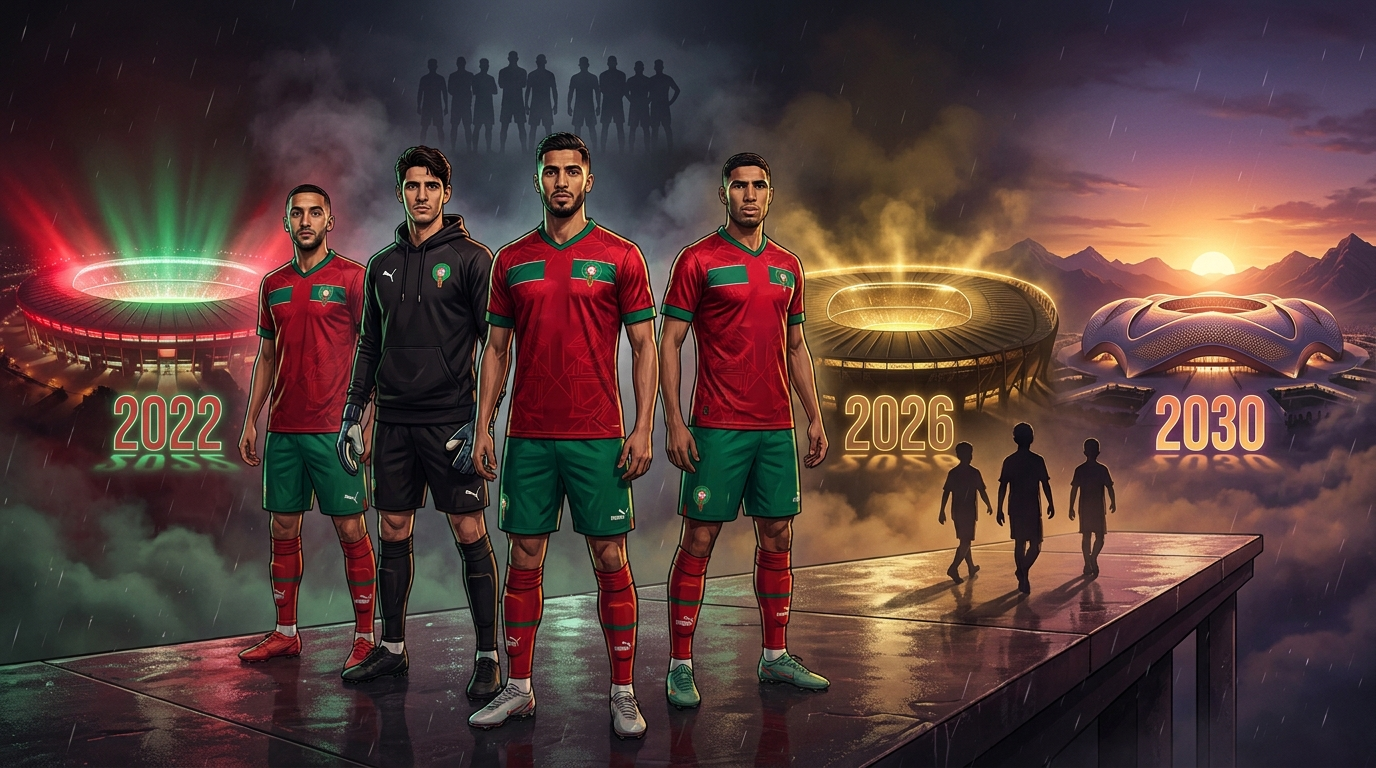
🚀 2022 → 2026 → 2030
From breakthrough to confirmation—and now toward the biggest challenge
Morocco reached the semi-finals and became the first African nation to enter the World Cup’s final four.
A second consecutive deep run proved that Morocco’s global competitiveness was no longer exceptional.
As co-host, Morocco must transform progress into greater control, deeper talent and a genuine title challenge.
Morocco’s Status Must Be Defended
No national team owns a permanent place among the elite.
Traditional powers decline.
Golden generations age.
Tactical innovations become familiar.
Other countries improve.
Morocco’s current status is therefore both an achievement and a responsibility.
The federation must continue investing.
Coaches must remain innovative.
Established players must accept competition.
Young players must be integrated through evidence rather than hype.
Supporters must maintain ambition without turning every setback into a crisis.
The Atlas Lions have earned the right to be discussed among the strongest national teams in the world.
They must now earn that right again at every major tournament.
That is how elite status works.
It is not awarded once.
It is renewed through performance.
MFT Verdict: Morocco Has Crossed the Line from Outsider to Contender
Morocco’s World Cup 2026 campaign did not end with the image the country wanted.
There was no semi-final, no final and no trophy.
But the tournament provided something essential: confirmation.
It confirmed that 2022 was not an isolated miracle.
It confirmed that Morocco can survive knockout pressure in different ways.
It confirmed that the team’s reputation is supported by structure.
It confirmed that opponents now treat the Atlas Lions as a serious threat.
It confirmed that Moroccan football has created expectations that once seemed unrealistic.
This is why Morocco belongs among world football’s elite after World Cup 2026.
Not because the project is complete.
Not because defeat should be ignored.
Not because a quarter-final is automatically enough.
Morocco belongs because the country has built a repeatable level of international competitiveness—and because its next objectives are no longer about proving that success is possible.
The next objectives concern control, consistency and titles.
The Atlas Lions have moved beyond the age of surprise.
They have entered the age of responsibility.
❓ Frequently Asked Questions
Why does Morocco belong among world football’s elite?
Morocco reached the 2022 World Cup semi-finals and followed that achievement with a quarter-final appearance in 2026. The Atlas Lions have demonstrated repeatable knockout success, tactical organisation, mental resilience and a growing football-development system.
How far did Morocco go at the FIFA World Cup 2026?
Morocco reached the quarter-finals. The Atlas Lions eliminated the Netherlands in the Round of 32, defeated Canada 3–0 in the Round of 16 and were eliminated 2–0 by France.
Was Morocco’s 2022 World Cup run a one-off?
The 2026 quarter-final run suggests that 2022 was not an isolated achievement. Morocco progressed deeply again despite greater expectations and opponents being more familiar with the team’s strengths.
What must Morocco improve before the 2030 World Cup?
The main priorities are attacking variety, resistance against elite pressing, squad depth, youth integration and greater control during matches against the strongest international opponents.
Who will host the FIFA World Cup 2030?
Morocco, Portugal and Spain will co-host the tournament. Argentina, Paraguay and Uruguay will stage three centenary celebration matches.
Can Morocco win the World Cup in 2030?
Morocco have demonstrated the ability to reach the later knockout stages. Winning the tournament will require continued development, a deeper squad, greater attacking authority and effective management of the pressure associated with hosting.
🧠 Test Your Knowledge
How well did you understand why Morocco now belongs among world football’s elite? Test yourself with these five questions.
📚 Continue Reading
France vs Morocco Match Report →
Morocco vs Canada Match Report →
📣 Join the Conversation
What is the strongest argument that Morocco now belongs among world football’s elite?
- Consecutive deep World Cup runs
- Tactical organisation
- The quality of the player pool
- Investment in football development
- The ambition surrounding the 2030 World Cup
Share your opinion in the comments and continue following Morocco Football Tribune for independent analysis of the Atlas Lions and Moroccan football.
🔎 Sources and Editorial Note
This article combines verified tournament information from FIFA and Reuters with independent analysis by Morocco Football Tribune. Analytical conclusions and assessments represent MFT’s editorial interpretation of Morocco’s performances and long-term development.
Last reviewed: July 2026.
Les faits relatifs au parcours 2026, au quart de finale contre la France et à l’organisation du Mondial 2030 ont été vérifiés auprès de FIFA et Reuters.
Leave a Reply