
⚡ 30-Second Summary
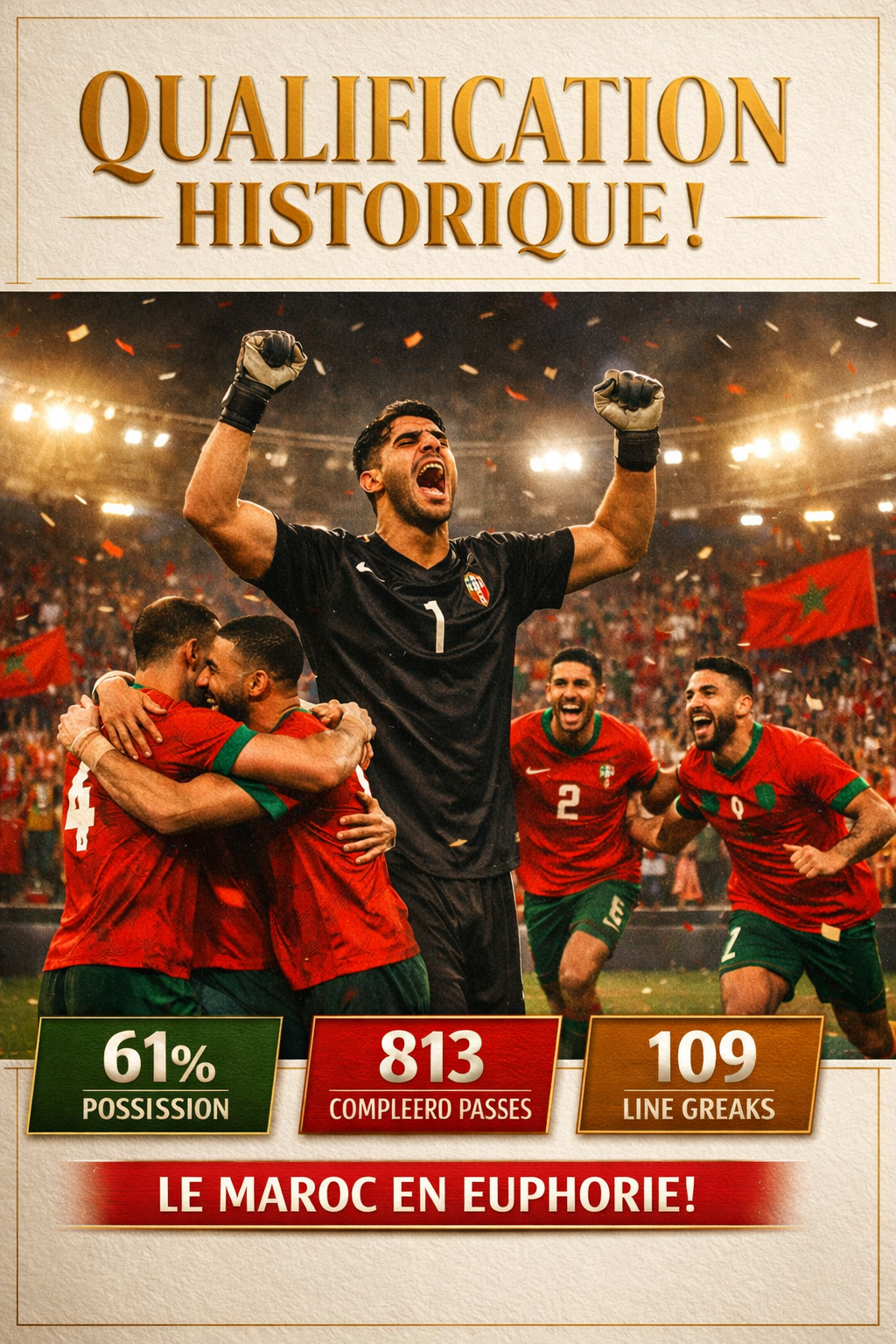
Morocco reached the FIFA World Cup 2026 Round of 16 after defeating the Netherlands 3–2 on penalties following a 1–1 draw in Monterrey.
Although the match remained level after 120 minutes, the official FIFA statistics reveal a very different story.
The Atlas Lions dominated possession, completed more than twice as many passes as the Netherlands and created significantly more attacking opportunities.
Morocco’s qualification was deserved, built on tactical discipline, technical quality and remarkable composure under pressure.
✔ MFT Fact Check
This match report is based exclusively on official FIFA World Cup 2026 statistics and verified competition data.
- ✔ Official FIFA Match Statistics
- ✔ Final Score Verified
- ✔ Player Names Verified
- ✔ Club Information Verified
- ✔ Competition Details Verified
- ✔ Tactical Analysis by Morocco Football Tribune
Last Updated: 1 July 2026
Morocco are through to the FIFA World Cup 2026 Round of 16 after defeating the Netherlands 3–2 in a dramatic penalty shootout following a 1–1 draw in Monterrey. While the shootout delivered the unforgettable ending, the official FIFA statistics tell the deeper story of a match largely controlled by the Atlas Lions.
Walid Regragui’s side dominated possession, completed more than twice as many passes as their opponents and consistently created the more dangerous attacking situations. The Netherlands showed resilience and forced the contest all the way to penalties, but Morocco’s tactical discipline, composure and collective organisation ultimately proved decisive.
In this complete Morocco Football Tribune match report, we analyse the key moments, the tactical battle, the standout performers and the official FIFA statistics that explain why Morocco fully deserved their place in the Round of 16.
🧠 MFT Match Quiz
Test your knowledge before reading the full match report.
Question 1
How did Morocco qualify for the Round of 16?
Question 2
Which team dominated possession?
Question 3
How many completed passes did Morocco record?
Question 4
How many shots did Morocco attempt?
🔵 Quick Facts
| Item | Detail |
|---|---|
| 🏆 Competition | FIFA World Cup 2026 |
| 📍 Stage | Round of 32 |
| 🏟️ Venue | Monterrey Stadium |
| ⚽ Match | Netherlands vs Morocco |
| ⏱️ Final Score | Netherlands 1–1 Morocco |
| 🥅 Penalty Shootout | Morocco win 3–2 |
| 🇲🇦 Morocco Possession | 61% |
| 🎯 Morocco Shots | 11 |
| ✅ Morocco Completed Passes | 813 |
| 📈 Result | Morocco qualify for the Round of 16 |
📊 Match Analytics
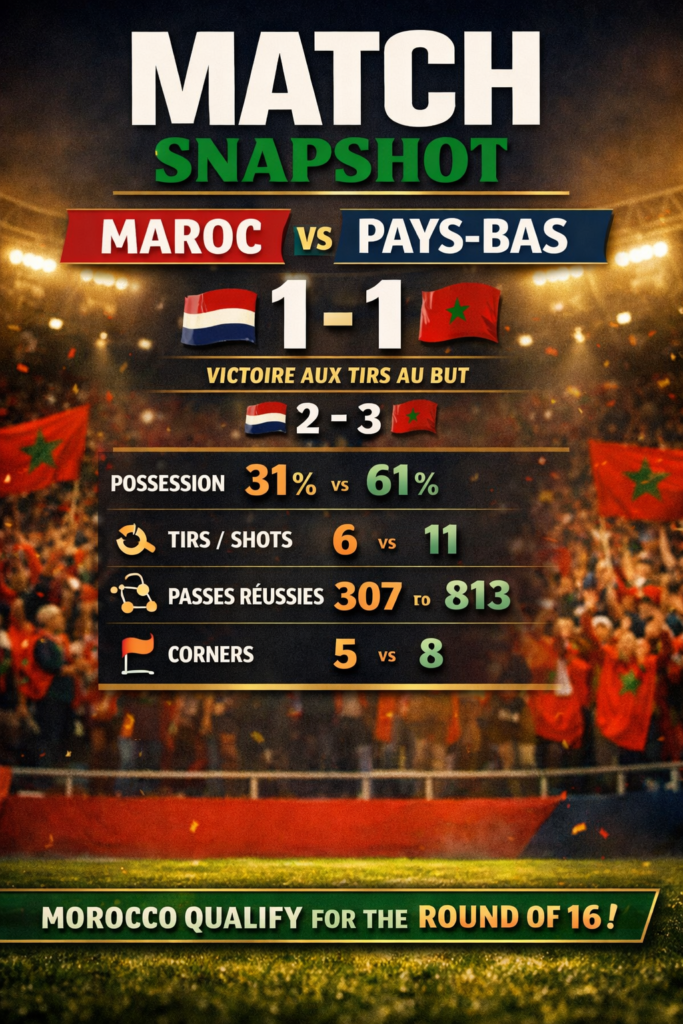
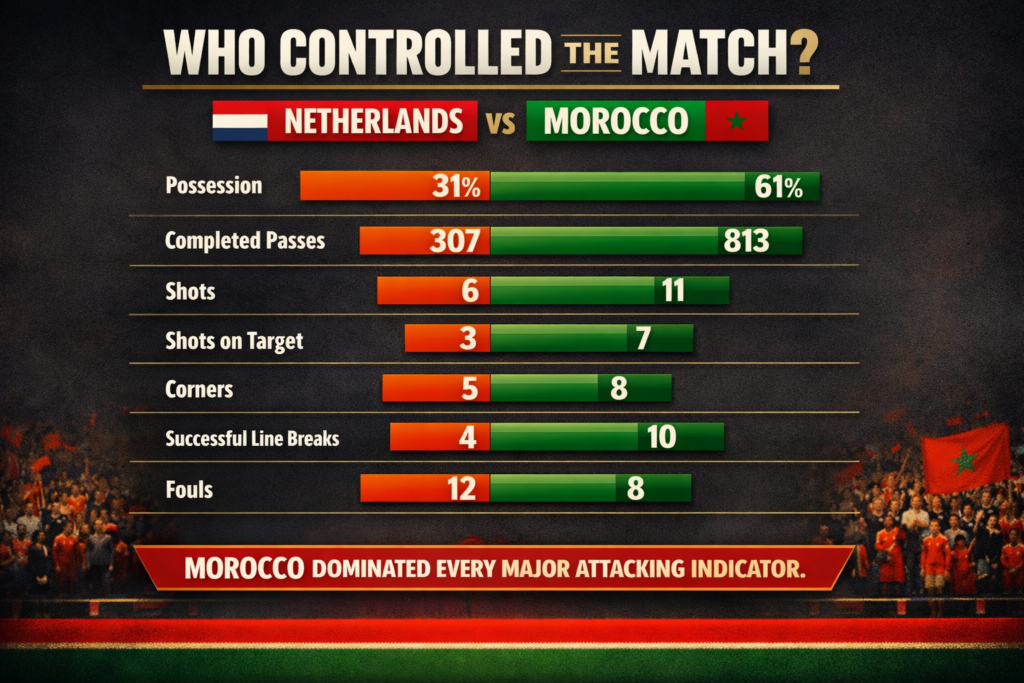
The final score remained level after 120 minutes, but the official FIFA statistics clearly highlight Morocco’s overall dominance throughout the match.
| Statistic | Netherlands | Morocco |
|---|---|---|
| ⚽ Goals | 1 | 1 |
| 📈 Possession | 31% | 61% |
| 🎯 Total Shots | 6 | 11 |
| 🥅 Shots on Target | 2 | 5 |
| 📦 Completed Passes | 307 | 813 |
| ⚡ Successful Line Breaks | 75 | 109 |
| 🚩 Corners | 5 | 8 |
| 🎯 Crosses Completed | 2 | 4 |
| 🟨 Yellow Cards | 0 | 1 |
| ❌ Offsides | 3 | 0 |
| 🤝 Fouls Committed | 18 | 15 |
MFT Analysis: Morocco controlled the rhythm of the match through superior possession, passing accuracy and chance creation. Although the score remained tied after extra time, the FIFA statistics suggest the Atlas Lions were the more complete side before eventually prevailing in the penalty shootout.
How the Match Unfolded
Morocco’s qualification was the result of 120 minutes of discipline, tactical intelligence and resilience rather than a moment of luck in the penalty shootout. Although the final score remained locked at 1–1 after extra time, the Atlas Lions consistently imposed their game on one of Europe’s strongest footballing nations.
From the opening whistle, Morocco looked determined to control possession instead of sitting back. The midfield circulated the ball patiently, forcing the Netherlands to defend deeper than expected. Every sequence of passes gradually shifted the Dutch defensive block, creating space on the flanks and between the lines.
The Atlas Lions’ attacking intent was reflected in the official FIFA statistics. Morocco attempted 11 shots, including 5 on target, while the Netherlands managed only 6 attempts and 2 efforts on target. The difference was equally visible in territorial pressure, with Morocco winning 8 corner kicks compared to 5 for the Dutch side.
Despite Morocco’s dominance, the Netherlands remained dangerous whenever they recovered possession. Their transitions were direct and efficient, demonstrating why they have long been recognised as one of Europe’s most disciplined tournament teams. However, Morocco’s defensive organisation prevented those moments from becoming sustained periods of pressure.
As the match progressed into extra time, physical fatigue became increasingly visible. Yet Morocco continued to dictate the tempo through calm possession and intelligent ball circulation. Rather than rushing attacks, the Atlas Lions remained faithful to their tactical plan, confident that patience would eventually be rewarded.
When the referee signalled the end of extra time, the scoreline still showed parity. But the overall performance suggested a different reality. Morocco had controlled possession, created the better chances and consistently pushed the Netherlands onto the defensive. The penalty shootout simply confirmed what much of the previous 120 minutes had already indicated: the Atlas Lions had earned their place in the Round of 16.
The Tactical Battle That Decided the Match
For much of the evening in Monterrey, the tactical contest was shaped by one simple question: could Morocco maintain control against one of Europe’s most technically accomplished teams?
The answer was a convincing yes.
Rather than adopting a conservative approach, Walid Regragui’s side accepted responsibility for dictating the tempo. Morocco completed an outstanding 813 successful passes, while the Netherlands managed only 307. This remarkable difference illustrates far more than possession statistics—it reflects authority, confidence and tactical maturity.
Morocco’s midfield constantly offered passing options, allowing the team to circulate the ball with patience before accelerating into dangerous areas. The FIFA data highlights this superiority through 464 offensive support movements, compared with 192 for the Netherlands. Every phase of possession was supported by intelligent movement off the ball, giving the player in possession multiple passing lanes and reducing the risk of turnovers.
The Atlas Lions were equally impressive when progressing through the Dutch defensive structure. Morocco completed 109 successful line breaks, compared with 75 by the Netherlands, while also recording 10 successful defensive line breaks, more than double the Dutch total of 4. These numbers demonstrate Morocco’s ability not only to retain possession but also to transform it into meaningful attacking progression.
The wide areas became another decisive battleground. Morocco repeatedly exploited both flanks, recording 35 entries down the right wing and 24 down the left, stretching the Dutch defensive block and creating space in central areas. This balanced attacking approach prevented the Netherlands from focusing their defensive efforts on a single side of the pitch.
Without the ball, Morocco displayed remarkable discipline. Although the Netherlands attempted to increase their pressing intensity, the Atlas Lions rarely panicked. Their structured build-up consistently bypassed the first line of pressure, forcing the Dutch to defend deeper than they would have preferred.
Perhaps the most telling statistic concerns composure. Despite playing 120 minutes in one of the most demanding fixtures of the tournament, Morocco committed only 15 fouls, compared with 18 by the Netherlands, and avoided a single offside throughout the match. These figures underline a performance based on control rather than desperation.
Ultimately, the penalty shootout decided the official winner, but the tactical battle had already been won long before the first penalty was taken. Morocco controlled possession, dictated the rhythm, progressed through the lines with greater efficiency and consistently created the more dangerous attacking situations. The Atlas Lions did not simply survive against the Netherlands—they outplayed them over the course of the match. The tactical patterns observed in Monterrey were not entirely surprising. Several of the key battles that shaped the outcome—including Morocco’s superiority in midfield, the importance of controlling the flanks and the role of transitional defending—had already been identified before kick-off. If you would like to compare the pre-match expectations with what actually happened on the pitch, read our complete tactical preview before the match.
💡 Did You Know?
Morocco completed 813 successful passes against the Netherlands — more than 2.6 times the Dutch total of 307 completed passes. This remarkable difference illustrates how the Atlas Lions controlled possession and dictated the tempo throughout the match.
⭐ MFT Player of the Match
Yassine Bounou (Al Hilal)
When the pressure reached its highest point, Yassine Bounou once again demonstrated why he remains one of the world’s most reliable goalkeepers. Throughout the match, he organised Morocco’s defence with authority and composure. His leadership became even more decisive during the penalty shootout, where calmness and experience proved invaluable. Although Morocco dominated possession and created more chances, Bounou ensured that every defensive effort counted, giving his teammates the confidence to play their football.
| Performance | Rating |
|---|---|
| Leadership | ★★★★★ |
| Decision Making | ★★★★★ |
| Penalty Shootout | ★★★★★ |
| Distribution | ★★★★☆ |
| Overall Rating | 9.4 / 10 |
MFT Verdict: Bounou’s composure under immense pressure once again proved decisive. His experience and leadership were fundamental to Morocco’s qualification for the Round of 16.
What the FIFA Statistics Really Reveal
The final score alone does not tell the full story of Morocco’s victory. A 1–1 draw followed by a 3–2 penalty shootout success suggests a perfectly balanced contest, but the official FIFA statistics reveal that the Atlas Lions were the more dominant side across almost every major performance indicator.
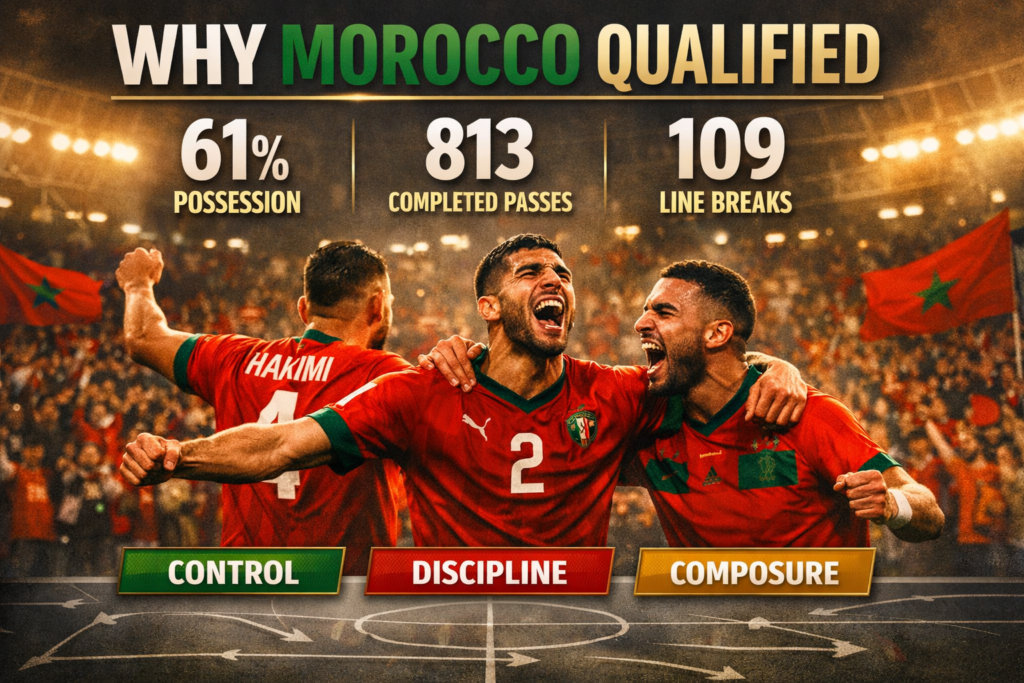
Possession provides the clearest example. Morocco controlled 61% of the ball, limiting the Netherlands to just 31%. Against one of Europe’s most technically accomplished teams, this level of control is remarkable and reflects Morocco’s confidence in building attacks patiently from the back.
The passing numbers reinforce that impression. Morocco attempted 891 passes, completing 813 of them with excellent accuracy. By comparison, the Netherlands completed only 307 passes. This difference illustrates Morocco’s ability to dictate the rhythm of the game while forcing the Dutch to spend long periods defending without possession.
The attacking statistics also favour the Atlas Lions. Morocco produced 11 shots, including 5 on target, compared with 6 shots and only 2 on target for the Netherlands. The Atlas Lions also earned 8 corners, demonstrating sustained territorial pressure throughout the match.
Another revealing statistic concerns progression through the opposition’s defensive structure. Morocco successfully completed 109 line breaks, significantly more than the Netherlands’ 75, while also recording 10 successful defensive line breaks, compared with only 4 for their opponents. These figures show that Morocco consistently found ways to advance the ball into dangerous positions rather than circulating possession without purpose.
Even the disciplinary numbers underline Morocco’s maturity. Despite playing 120 demanding minutes, the Atlas Lions committed fewer fouls than the Netherlands and avoided a single offside. Their decision-making remained composed, even during the most intense phases of the match.
Taken together, these statistics explain why Morocco deserved to progress. While penalty shootouts often introduce an element of uncertainty, the broader data confirms that the Atlas Lions had already established themselves as the superior team long before the decisive kicks from the penalty spot.
📈 MFT Performance Meter
Morocco’s victory was built on control, discipline and emotional strength. The scoreline remained tight, but the performance indicators show a complete knockout display from the Atlas Lions.
| Category | Rating | MFT Verdict |
|---|---|---|
| 🛡 Defensive Organisation | ★★★★★ | Morocco stayed compact and limited the Netherlands to only 2 shots on target. |
| 📈 Possession Control | ★★★★★ | 61% possession against a traditionally possession-based Dutch side. |
| 🎯 Chance Creation | ★★★★☆ | 11 shots and 5 on target, but Morocco could have killed the game earlier. |
| ⚡ Line Breaks | ★★★★★ | 109 successful line breaks showed Morocco’s ability to progress through the Dutch structure. |
| 💪 Mental Strength | ★★★★★ | Morocco remained composed during the penalty shootout. |
| 🧠 Tactical Maturity | ★★★★★ | The Atlas Lions controlled the rhythm and managed pressure intelligently. |
Overall MFT Performance Rating: 9.3 / 10
⏱ Match Timeline
A quick visual timeline of the key moments from Morocco’s dramatic qualification against the Netherlands.
Netherlands and Morocco begin their Round of 32 clash in Monterrey.
Morocco control possession and prevent the Netherlands from imposing their usual rhythm.
Both teams find the net, but Morocco continue to create the stronger overall attacking numbers.
The match remains level at 1–1 and goes to extra time.
Morocco stay organised and composed despite the physical and mental pressure.
Morocco win 3–2 on penalties and qualify for the Round of 16.
📊 Match Infographic
The infographic below highlights the most important statistics and key moments of the match.
What This Victory Means for Morocco
Morocco’s qualification for the Round of 16 represents far more than a place in the next round. It confirms the continued evolution of the Atlas Lions into one of the most tactically mature teams at the FIFA World Cup 2026.
Eliminating the Netherlands, a nation with one of football’s richest tactical traditions, sends a powerful message to the rest of the tournament. Morocco demonstrated that they can compete not only through defensive organisation but also by controlling possession, dictating the tempo and creating sustained attacking pressure against elite opposition.
The performance also reinforces the identity that Walid Regragui has built over recent years. His team remains disciplined without the ball, but it is now equally comfortable dominating possession when the tactical situation demands it. This versatility makes Morocco one of the most difficult teams to prepare for in the knockout stage.
Confidence will be another important consequence of this victory. Winning a penalty shootout on the World Cup stage requires composure, belief and collective resilience. Those qualities are likely to become invaluable as the level of opposition continues to rise.
However, Morocco cannot afford complacency. The Round of 16 presents a new challenge against Canada, a team that combines physical intensity with rapid transitions. The Atlas Lions will need to reproduce the same concentration, tactical discipline and efficiency shown against the Netherlands if they hope to continue their journey toward the quarter-finals.
For Moroccan supporters, this qualification is another milestone in the remarkable rise of the national team. For the players, it is simply the next step. Their ambition extends beyond reaching the knockout stage—they now have a genuine opportunity to establish another historic chapter in Moroccan football.
📚 Continue Reading
Enjoyed this match report? Continue exploring Morocco’s FIFA World Cup 2026 journey with our in-depth analysis and exclusive coverage.
MFT Verdict
Morocco’s qualification was anything but fortunate. While the penalty shootout provided the decisive moment, the Atlas Lions had already established themselves as the better side over the course of 120 minutes. The official FIFA statistics leave little room for debate: Morocco dominated possession, completed more than twice as many passes as the Netherlands, created more chances and consistently controlled the rhythm of the game.
Beyond the numbers, this performance highlighted the remarkable maturity of Walid Regragui’s squad. Morocco showed tactical flexibility, emotional resilience and the ability to adapt to different phases of the match without abandoning its identity. Whether building patiently from the back, defending in a compact block or managing the pressure of extra time, the Atlas Lions looked composed and confident.
One of the most encouraging aspects of this victory was the team’s collective approach. Rather than relying on individual brilliance, Morocco succeeded through organisation, intelligent movement and disciplined execution of the game plan. Every player contributed, both in and out of possession, creating a balanced performance that deserved its reward.
The penalty shootout will inevitably dominate the highlights, but it should not overshadow the quality of Morocco’s football. Against one of Europe’s traditional powerhouses, the Atlas Lions demonstrated that they are capable of controlling matches at the highest level of international football.
If Morocco can reproduce this level of discipline, tactical intelligence and confidence, they will travel to the Round of 16 not simply as outsiders, but as genuine contenders capable of extending their remarkable World Cup journey.
❓ Frequently Asked Questions
Did Morocco deserve to beat the Netherlands?
Yes. Morocco dominated several key FIFA statistics, including possession, shots, completed passes, corners and successful line breaks. The penalty shootout decided the result, but the overall performance showed Morocco controlled large parts of the match.
What was the final score between Morocco and the Netherlands?
The match ended Netherlands 1–1 Morocco after extra time. Morocco then won 3–2 on penalties.
How did Morocco qualify for the Round of 16?
Morocco qualified by defeating the Netherlands in the penalty shootout after the match finished level at 1–1.
Which statistic best explains Morocco’s dominance?
Completed passes. Morocco completed 813 passes, compared to 307 for the Netherlands, showing a clear difference in control and rhythm.
Who was MFT Player of the Match?
Morocco Football Tribune selected Yassine Bounou as Player of the Match for his composure, leadership and decisive role during the penalty shootout.
📢 Join the Conversation
What did you think of Morocco’s performance against the Netherlands?
👉 Was this Morocco’s most convincing performance of the FIFA World Cup 2026 so far?
Share your opinion in the comments below and tell us who was your Player of the Match.
Follow Morocco Football Tribune for exclusive match reports, tactical analysis, player ratings and the latest FIFA World Cup 2026 coverage.
Leave a Reply