
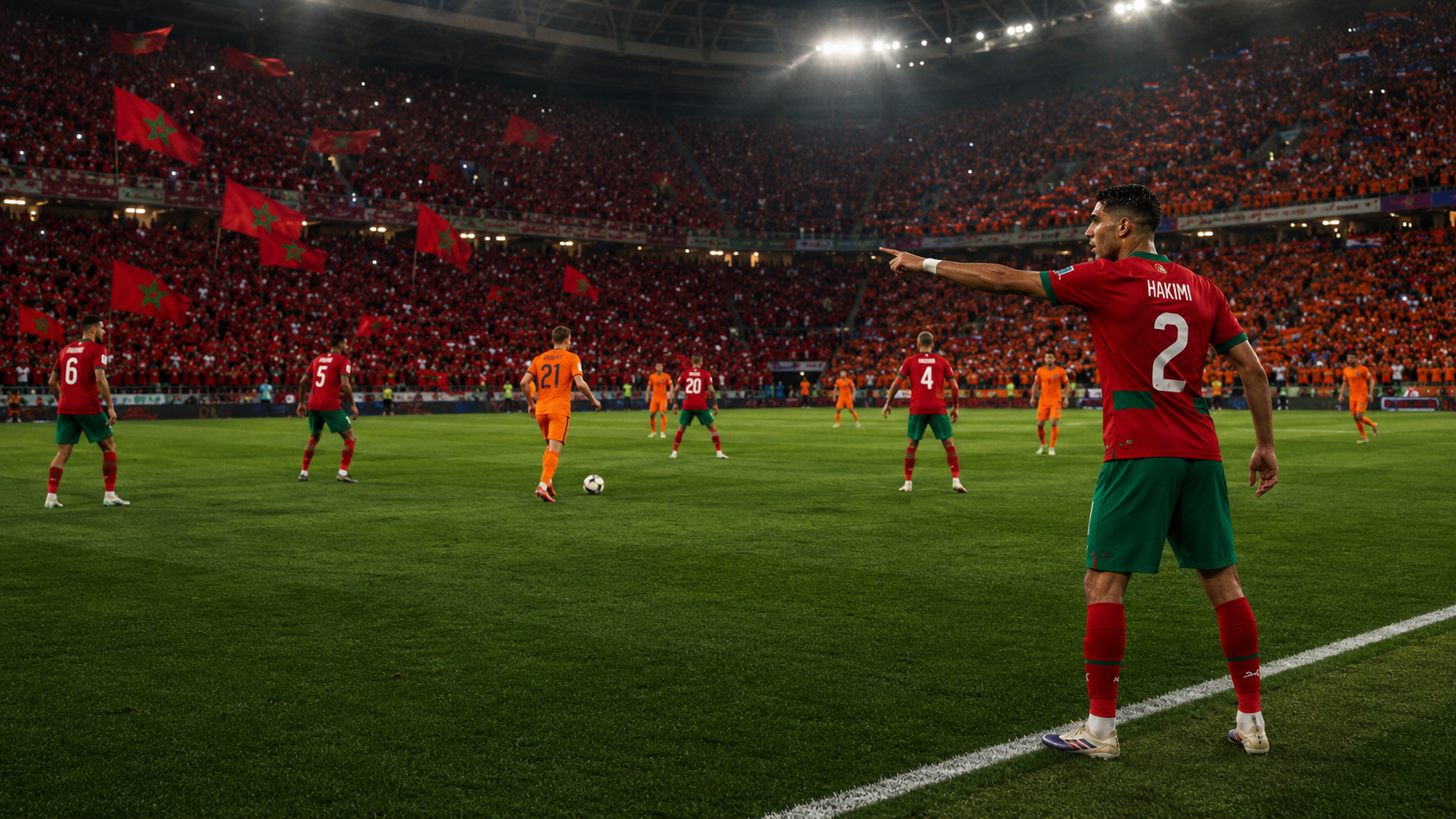
Knockout football is rarely decided by possession alone.
When Morocco face the Netherlands in the FIFA World Cup 2026 Round of 32, the result is likely to depend on a handful of tactical duels rather than overall statistics. One successful press, one defensive adjustment or one well-executed transition could separate qualification from elimination.
Morocco have already shown during the group stage that they can adapt to different opponents. That adaptability was one of the main reasons behind Morocco’s unbeaten campaign. Read our complete How Morocco Qualified for the FIFA World Cup 2026 Knockout Stage. Against Brazil, the Atlas Lions relied on defensive discipline and compactness. Against Scotland, they demonstrated patience and game management. Against Haiti, they revealed a more aggressive attacking side capable of creating sustained pressure.
The Netherlands present a different challenge. They combine technical quality, positional discipline and physical presence, making them one of the tournament’s most complete teams.
This match is therefore less about which team is stronger on paper and more about which team wins the key tactical battles across the pitch.
Here are the five areas that could ultimately decide who advances to the next round.
Match Snapshot
Competition
FIFA World Cup 2026
Round
Round of 32
Match
Morocco vs Netherlands
The Atlas Lions arrive unbeaten after collecting seven points during the group stage, while the Netherlands progressed after finishing first in Group F. The Official FIFA Match Centre provides the latest fixture information, confirmed schedules and tournament updates.
For a complete overview of the standings and qualification path, read Morocco Group C Standings: What the Atlas Lions Need to Qualify.
Both teams have shown different strengths throughout the tournament.
Morocco have relied on collective organisation, defensive balance and rapid attacking transitions.
The Netherlands have controlled matches through structured possession, intelligent movement and sustained territorial pressure.
These contrasting identities create one of the most intriguing tactical matchups of the Round of 32.
Rather than becoming an open attacking contest, this game is expected to be defined by spacing, positioning and decision-making in key moments.
Team News
Morocco
Morocco enter the knockout stage with confidence after three convincing performances built on tactical flexibility.
The Atlas Lions have shown that they can successfully adjust their game plan depending on the opposition. Their defensive block remained extremely difficult to break against Brazil, while their attacking approach became increasingly ambitious as the tournament progressed.
One of Morocco’s biggest assets has been collective discipline. Every phase of possession quickly transforms into defensive organisation, allowing the team to remain compact even against technically superior opponents.
Another encouraging sign has been Morocco’s ability to create danger through multiple attacking routes. The attacking display against Haiti illustrated that evolution perfectly. Read our complete Morocco vs Haiti Match Report. Wide combinations, quick transitions and set pieces have all contributed during the group stage.
Maintaining this tactical balance will be essential against the Netherlands.
Netherlands
The Netherlands have looked increasingly comfortable throughout the tournament.
Their approach is based on controlling space rather than simply controlling the ball. Patient circulation, intelligent positioning and coordinated pressing allow them to dictate the rhythm of many matches.
Defensively, the Dutch rarely lose their structure. Their compact shape limits central penetration and often forces opponents toward less dangerous areas.
Offensively, they create numerical superiority by moving players between the lines before accelerating attacks in the final third.
Morocco will therefore need concentration for the full ninety minutes.
Tactical Preview
Although this match features two technically gifted teams, the contest may ultimately become a battle between two very different football philosophies.
For our complete pre-match analysis, team news and score prediction, read the Morocco vs Netherlands Preview.
The Netherlands are expected to dominate possession for significant periods. Their objective will be to move Morocco’s defensive block from side to side until gaps appear between the lines.
Morocco, however, have repeatedly shown that they are comfortable without the ball.
Instead of pressing high continuously, the Atlas Lions often defend in a compact medium block before accelerating immediately after recovering possession. This approach reduces the amount of space available to creative opponents while maximising opportunities to attack quickly into open areas.
The strategic question is therefore straightforward:
Can the Netherlands move Morocco out of position before Morocco punish the spaces left behind during Dutch attacks?
Every tactical duel examined in this analysis ultimately comes back to that central question.
1. Morocco’s Compact Block vs Dutch Positional Play
The first tactical battle will take place before the Netherlands even reach the penalty area.
The Dutch are at their best when they can move opponents out of shape. Their positional play is designed to create passing angles, attract pressure and open central lanes. If Morocco’s defensive block becomes stretched, the Netherlands will find pockets between the midfield and defensive lines.
Morocco’s answer must be compactness.
The Atlas Lions do not need to chase every pass. They need to protect the central corridor, close gaps between the lines and force the Netherlands into slower, wider circulation. The less space the Dutch find centrally, the more predictable their attacks become.
This is where Morocco’s collective discipline becomes essential. The back line, midfield and forwards must move together. If one unit presses while another drops, the Netherlands will exploit the distance immediately.
Morocco’s defensive success will depend on patience. They must accept that the Netherlands may dominate possession without allowing that possession to become penetration.
If Morocco can keep the Dutch in front of them, the game becomes manageable.
2. Hakimi’s Right Flank vs Dutch Wide Overloads
Morocco’s right side is both a weapon and a risk.
Achraf Hakimi gives the Atlas Lions one of the most dangerous attacking outlets in world football. When he receives the ball in space, he can carry Morocco forward instantly and turn defensive recovery into attacking momentum.
However, the Netherlands will understand this threat.
The Dutch may try to overload Morocco’s right flank by positioning multiple players in that channel. The objective would be to pin Hakimi deeper, reduce his forward runs and force Morocco to defend rather than counterattack.
This duel could shape the entire match.
If Hakimi is forced to defend constantly, Morocco lose one of their main transition weapons. But if Morocco can release him at the right moments, the Dutch left side could become vulnerable.
The key will be timing. Hakimi does not need to attack every phase. He needs to choose the correct moments to accelerate, especially after Morocco recover possession and the Netherlands are still reorganising defensively.
A single well-timed run could change the match.
3. Midfield Control: Morocco’s Screen vs Dutch Central Rotation
The midfield battle may be the most important zone of all.
The Netherlands rely heavily on central rotation. Their midfielders move constantly to create new passing lanes, drag markers out of position and connect defence to attack. This movement is difficult to defend because the danger does not always come from one fixed player.
Morocco must respond with intelligence rather than aggression.
If the Atlas Lions follow every Dutch movement individually, they risk opening gaps. Instead, they need a disciplined midfield screen that protects space first and opponents second.
The role of Morocco’s holding midfielder will be critical. He must prevent vertical passes, cover second balls and slow down transitions when the Netherlands recover possession.
This battle will not always be spectacular. It may be decided by subtle positioning: one blocked passing lane, one intercepted ball, one delayed attack.
If Morocco win enough of these small moments, they can prevent the Netherlands from building rhythm.
4. Dutch High Defensive Line vs Moroccan Runs in Behind
The Netherlands are comfortable defending high when they control possession.
That structure allows them to press immediately after losing the ball and keep opponents far from their goal. But it also creates a clear vulnerability: space behind the defensive line.
Morocco must be prepared to attack that space quickly.
This does not mean playing long balls without purpose. It means identifying the right moment to release runners before the Dutch defence can drop.
Timing will matter more than speed alone.
If Morocco’s attackers move too early, they will be caught offside. If they move too late, the Dutch defenders will recover their shape. The perfect counterattack requires precision: recovery, first pass, forward run, final decision.
Against a team like the Netherlands, Morocco may only get a few clean transition opportunities. Those moments must be treated as premium chances.
This is where efficiency becomes decisive.
5. Set Pieces and Second Balls
Knockout matches often turn on moments that appear small.
A corner. A free kick. A loose ball. A second contact inside the box.
Set pieces could become a major factor in Morocco vs Netherlands because both teams have reasons to believe they can be dangerous in these phases.
Morocco have created repeated pressure from wide deliveries during the tournament, especially when they can attack the box with several runners. Their ability to win second balls and keep attacks alive could trouble the Dutch defence.
The Netherlands, however, are physically strong and well organised in aerial duels. Morocco must therefore be precise with delivery and aggressive with positioning.
Defensively, Morocco cannot afford unnecessary fouls near the box. Giving the Netherlands repeated dead-ball situations would increase the risk of conceding from a single lapse in concentration.
In a tight match, the set-piece battle could decide everything.
Predicted Tactical Shapes
This article is not a predicted lineups piece, so the focus is on tactical shapes rather than specific names.
Morocco’s Likely Shape
Morocco are likely to defend in a compact 4-1-4-1 or 4-5-1 structure without the ball.
The priority will be to protect central areas, reduce space between the lines and force the Netherlands toward the wings.
In possession, Morocco may shift quickly into a more aggressive shape, using the right flank and fast forward runs to attack spaces behind the Dutch defence.
The transition from defence to attack must be immediate, but controlled.
Netherlands’ Likely Shape
The Netherlands are expected to use a possession-heavy structure that can resemble a 3-2-5 or 4-3-3 depending on the phase of play.
Their objective will be to create overloads in midfield, push wide players high and keep Morocco pinned inside their own half.
Their defensive transition will also be crucial. If the Netherlands lose the ball with too many players ahead of it, Morocco can attack directly.
MFT Tactical Prediction
This match will probably be decided by control versus timing.
The Netherlands will try to control territory, possession and rhythm. Morocco will try to control space, transitions and emotional momentum.
If the Dutch score early, Morocco may be forced to open up, which would make the match more difficult. But if Morocco keep the score level for long periods, pressure could gradually shift toward the Netherlands.
The Atlas Lions’ best path is clear: stay compact, protect the centre, survive Dutch possession spells and attack with speed when space appears.
Morocco do not need to dominate the match to win it. They need to dominate the moments that matter.
Score Prediction
From a tactical perspective, this match looks extremely tight.
The Netherlands may create more possession and territory, but Morocco have the structure to limit clear chances and the transition quality to hurt them.
A low-scoring match is likely.
MFT Prediction
Netherlands 1-1 Morocco after 90 minutes.
The match could realistically go to extra time or penalties.
If Morocco score first, the tactical balance changes completely. The Netherlands would be forced to push higher, increasing the value of Morocco’s counterattacks.
What’s Next?
The winner of Morocco vs Netherlands will advance to the Round of 16, where the level of tactical detail becomes even more important.
For Morocco, this match is an opportunity to prove once again that their strength is not based only on emotion or defensive courage. It is built on structure, discipline and intelligent adaptation.
If the Atlas Lions win the key tactical battles, they will have a real chance to extend their World Cup journey. After the final whistle, Morocco Football Tribune will publish the Match Report, Tactical Review and Player Ratings for complete post-match coverage.
MFT Key Takeaways
- Morocco must keep their defensive block compact.
- The Netherlands will try to create central passing lanes through positional play.
- Achraf Hakimi’s right flank could be Morocco’s most important transition weapon.
- The midfield screen must prevent Dutch central rotation from becoming dangerous.
- Space behind the Dutch defensive line could offer Morocco valuable attacking opportunities.
- Set pieces and second balls may decide a tight knockout match.
- Morocco’s route to victory depends on discipline, timing and efficiency.
FAQ
What is the biggest tactical battle in Morocco vs Netherlands?
The biggest tactical battle is Morocco’s compact defensive block against the Netherlands’ positional play. If Morocco protect central areas effectively, they can limit the Dutch attack.
How can Morocco hurt the Netherlands?
Morocco can hurt the Netherlands through fast transitions, wide attacks and runs behind the Dutch defensive line.
Will the Netherlands dominate possession?
The Netherlands are expected to have more possession, but that does not guarantee control of the match if Morocco defend compactly and counterattack efficiently.
Why is Achraf Hakimi important in this match?
Hakimi is important because he gives Morocco speed, width and attacking threat on the right flank. His timing in transition could be decisive.
What should Morocco avoid?
Morocco must avoid losing compactness, conceding unnecessary fouls near the box and allowing the Netherlands to receive the ball freely between the lines.
Could the match go to extra time?
Yes. Given the tactical balance between the two teams, extra time or penalties are realistic possibilities.
Fans can also consult the Official FIFA Competition Regulations to understand the knockout format, extra time and penalty shootout procedures.
What is the MFT prediction?
MFT predicts a tight 1-1 draw after 90 minutes, with the match potentially decided in extra time or penalties.
Leave a Reply