History Rarely Offers Second Chances
Some football matches are remembered for the goals.
Others are remembered for the trophies they decide.
And then there are matches that become something far greater. They become symbols.
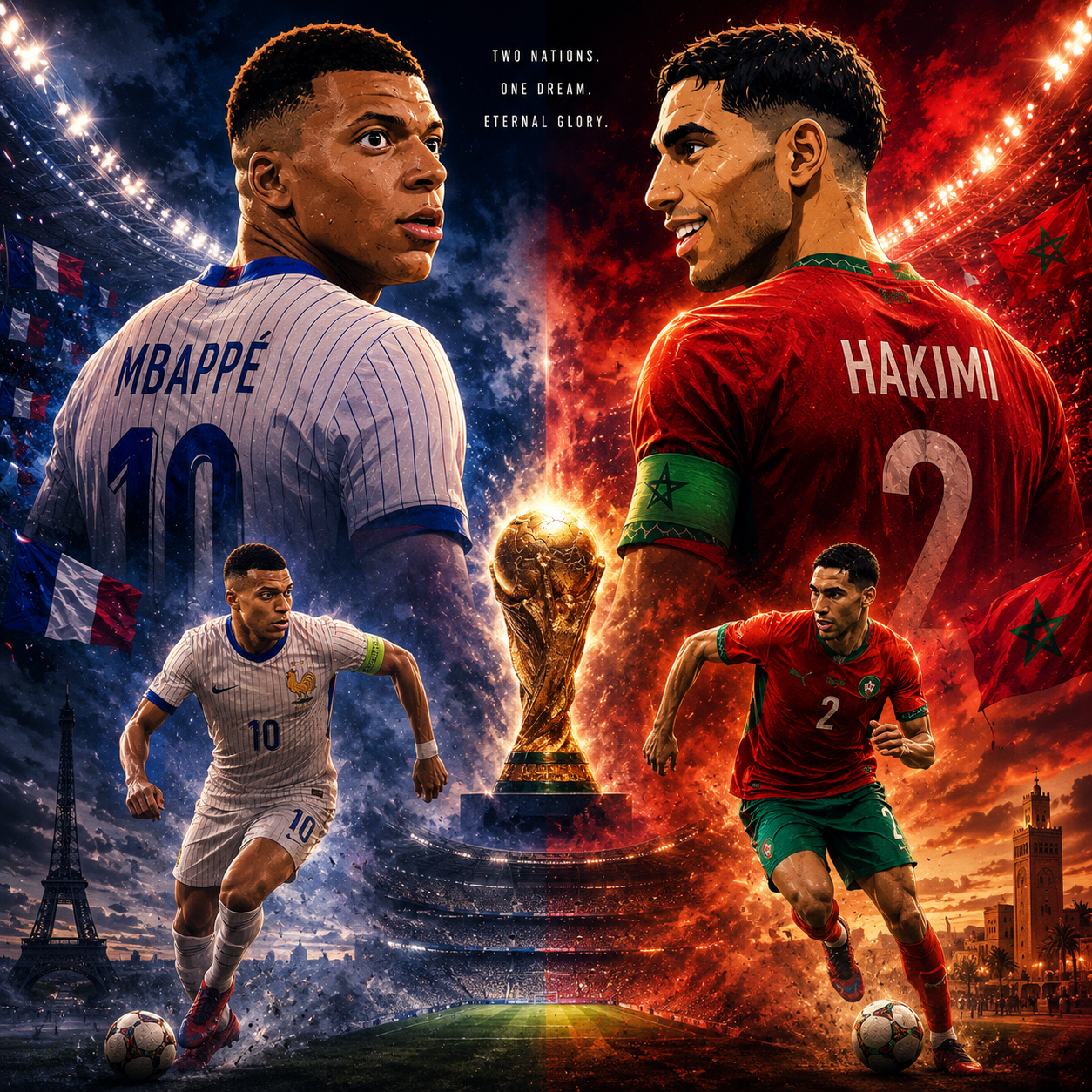
On 9 July 2026, Morocco and France will meet once again on football’s biggest stage, this time in a FIFA World Cup quarter-final that carries far more weight than a place in the last four. It is a meeting between two nations whose footballing stories have become deeply intertwined over the last decade, shaped by shared history, elite talent and unforgettable World Cup nights.
For Morocco, this is not simply another knockout match.
It is another opportunity to prove that what happened in Qatar four years ago was never a miracle.
It was the beginning of a new era.
A Different Morocco
When Morocco reached the semi-finals of the 2022 FIFA World Cup, millions of supporters celebrated one of the greatest achievements ever accomplished by an African nation.
The Atlas Lions defeated Belgium.
They eliminated Spain after an extraordinary defensive display.
They survived Portugal’s relentless pressure.
They inspired an entire continent.
Yet despite those remarkable performances, one narrative continued to follow them.
Many observers described Morocco as football’s ultimate underdog.
A courageous team.
A disciplined team.
A team driven by emotion.
But perhaps not one capable of repeating such an achievement.
Four years later, that perception has changed.
Morocco no longer arrives at major tournaments hoping to surprise the football world. This evolution is rooted in a wider football culture that has made Moroccan football unique in Africa, combining tactical discipline, emotional intensity and a powerful national identity.
They arrive expecting to compete with its very best.
That transformation may be the greatest victory of all.
The Road Back to the World’s Elite
The journey to this quarter-final has reflected Morocco’s growing maturity.
After progressing through the group stage with confidence, the Atlas Lions faced the Netherlands in one of the tournament’s most dramatic Round of 32 encounters.
For more than 120 minutes, both teams pushed each other to the limit before Morocco held their nerve in the penalty shootout, demonstrating not only technical quality but extraordinary psychological resilience.
That victory alone could have satisfied many teams.
Instead, Morocco produced an even stronger statement.
Against co-hosts Canada in Houston, the Atlas Lions delivered one of their most complete performances of the tournament, winning 3-0 to secure a place in the quarter-finals. The scoreline reflected Morocco’s clinical finishing, but it also highlighted something deeper: this team now knows how to manage pressure, control momentum and punish opponents when opportunities appear. Reuters described the victory as another landmark performance led by a brace from Azzedine Ounahi and a late goal from Soufiane Rahimi.
For the second consecutive knockout round, Morocco displayed a quality that separates good international teams from genuine contenders.
Patience.
France: The Standard Every Champion Must Meet
Standing between Morocco and another historic milestone is one of international football’s most successful tournament nations.
France rarely dominate headlines with spectacular football during the knockout stages.
They rarely need to.
For more than two decades, Les Bleus have mastered something far more valuable:
Winning.
Against Paraguay in the Round of 16, France once again demonstrated why experience matters in tournament football. The match remained tense until a decisive penalty converted by Kylian Mbappé separated the two teams, sending France into another World Cup quarter-final. It was not their most dazzling performance, but it was another reminder that championship teams often succeed by remaining composed rather than spectacular.
That ability makes France exceptionally dangerous.
They do not panic.
They do not chase games unnecessarily.
They wait.
They manage moments.
And when an opponent finally makes one mistake…
France usually punish it.
Beyond Revenge
Every conversation surrounding this match inevitably returns to one date.
14 December 2022.
That evening in Qatar, Morocco became the first African nation ever to reach a FIFA World Cup semi-final.
Although France ultimately won, the match changed how the football world viewed Moroccan football forever.
It was no longer enough to admire Morocco’s passion.
The Atlas Lions had demonstrated tactical intelligence, defensive organisation and technical quality capable of competing with the strongest footballing nations on Earth.
That memory will inevitably accompany both teams into this quarter-final.
But reducing this encounter to a simple story of revenge would be missing the bigger picture.
This is not Morocco trying to rewrite the past.
It is Morocco trying to shape its future.
More Than Eleven Players
One of Morocco’s greatest strengths cannot be measured by possession statistics or expected goals.
It is belief.
Every major tournament creates one team capable of inspiring something beyond football itself.
In 2022, Morocco united supporters across Africa, the Arab world and millions of neutrals who admired their courage.
In 2026, that emotional connection remains stronger than ever.
Wherever the Atlas Lions play, stadiums become seas of red. That atmosphere is not accidental; it reflects the deep connection between stadium culture and Moroccan football identity.
Flags wave long before kick-off.
Entire families travel thousands of kilometres.
Songs echo through the concourses hours before players even begin their warm-up.
The players notice it.
Opponents notice it.
And perhaps most importantly…
Morocco believe it.
That collective confidence has become one of their greatest competitive advantages.
Why This Quarter-Final Feels Different
History tells us that France enter this match with greater tournament experience.
The bookmakers may even place them among the favourites.
But football rarely rewards history alone.
Momentum matters.
Collective chemistry matters.
Defensive discipline matters.
And above all…
Belief matters.
Morocco arrive in Boston no longer carrying the weight of proving they belong among football’s elite.
That question has already been answered.
The challenge now is something entirely different.
Can the Atlas Lions transform respect into greatness?
Tactical Breakdown: Where This Quarter-Final Could Be Won or Lost
Every World Cup quarter-final has its defining moments.
Sometimes it is a piece of individual brilliance.
Sometimes it is a tactical adjustment made at half-time.
More often than not, however, these matches are decided by details that remain invisible to the casual viewer.
Against France, Morocco cannot rely solely on courage or emotion. The Atlas Lions will need to produce one of their most intelligent tactical performances of the tournament. Every line of the team—from the goalkeeper to the centre-forward—must work as a single unit.
This is not simply a battle between two talented squads.
It is a chess match played at full speed.
The Battle of Midfield Control
If there is one area capable of deciding the outcome, it is the midfield.
Modern international football is no longer dominated by possession statistics alone. What matters is where possession is won and how quickly a team can transform defensive recoveries into dangerous attacks.
Against Canada, Morocco’s midfield demonstrated remarkable balance. Azzedine Ounahi dictated the tempo with intelligent movement between the lines, while his late runs into the penalty area constantly disrupted Canada’s defensive organisation. His two goals were the reward for reading the game better than anyone else on the pitch.
France will present a completely different challenge.
Unlike Canada, Les Bleus rarely allow opponents to settle into comfortable passing rhythms. Their midfield presses selectively rather than continuously, forcing opponents into rushed decisions before exploiting mistakes in transition.
For Morocco, the objective will not be to dominate possession.
It will be to dominate moments.
Transition Football: France’s Greatest Weapon
France have developed a reputation for something that often goes unnoticed.
They do not need long spells of possession to create danger.
Instead, they specialise in transitional football.
A misplaced pass.
A failed dribble.
A poor corner.
Within seconds, France can transform a defensive action into a goalscoring opportunity.
That is why Morocco’s attacking structure will be just as important as its defensive organisation.
Whenever the Atlas Lions attack, they must ensure enough players remain behind the ball to slow any French counterattack.
Against elite opposition, losing defensive balance for just three seconds can decide an entire tournament.
Morocco’s Defensive Block
One of Morocco’s defining characteristics over recent years has been defensive compactness.
The distances between defenders and midfielders are usually short.
Passing lanes into dangerous central areas are quickly closed.
Opponents are often forced wide, where crosses become easier to defend.
This defensive identity has frustrated some of the world’s strongest attacking teams.
However, France possess qualities capable of stretching even the best-organised defensive block.
Quick diagonal runs.
Rotating attacking positions.
Late arrivals into the penalty area.
Explosive acceleration during transitions.
Maintaining concentration for ninety minutes will therefore be essential.
One lapse could be enough.
Five Key Battles That Could Decide the Match
1. Morocco’s Defensive Organisation vs France’s Pace
France’s forwards thrive when matches become stretched.
Morocco’s first objective must therefore be to keep the game compact.
The smaller the spaces between the defensive lines, the fewer opportunities France will have to attack at speed.
Discipline—not desperation—will be Morocco’s strongest defensive weapon.
2. The Midfield Intelligence Test
This is unlikely to become an open end-to-end contest.
Instead, the midfield battle will revolve around positioning, anticipation and decision-making.
Can Morocco resist the temptation to force risky passes?
Can France prevent Morocco from progressing through central areas?
Whoever answers these questions more effectively may control the rhythm of the game.
3. Set Pieces
Knockout football regularly rewards teams capable of exploiting dead-ball situations.
Corners.
Indirect free-kicks.
Long throw-ins.
Second balls.
Morocco have shown increasing confidence from set pieces throughout the tournament, while France possess considerable aerial strength at both ends of the pitch.
This could easily become the difference between elimination and qualification.
4. Emotional Control
World Cup quarter-finals are rarely decided only by tactics.
Pressure changes everything.
One early yellow card.
One controversial refereeing decision.
One missed opportunity.
Morocco must avoid allowing emotion to dictate their football.
France have built their recent tournament success on remaining composed in precisely these situations.
The Atlas Lions will need the same emotional discipline.
5. Efficiency Inside Both Penalty Areas
Statistics often tell only part of the story.
In knockout football, efficiency matters more than volume.
The team that converts one difficult chance often defeats the team that creates five easier ones.
Against Canada, Morocco demonstrated ruthless finishing.
Against France, those opportunities will almost certainly be fewer.
Every chance must count.
The Players Who Could Shape History
Every major tournament creates unexpected heroes. Morocco’s rise has also been shaped by a generation of players increasingly influencing modern African football at club and international level.
Morocco already know what Azzedine Ounahi can bring after his outstanding display against Canada. His ability to arrive late inside the box adds a dimension that few midfielders possess.
Hakimi remains one of Morocco’s most influential leaders. His experience at the highest level of European football, combined with his pace and tactical intelligence, makes him crucial on both sides of the ball.
Goalkeeper Yassine Bounou has repeatedly demonstrated why he is considered one of the world’s finest shot-stoppers. In knockout football, a single save can become as valuable as a goal.
France, meanwhile, continue to rely on individual quality capable of changing matches instantly. Whether through pace, technical brilliance or composure under pressure, they possess several players able to punish even the smallest defensive error.
For Morocco, limiting those moments of individual brilliance will be just as important as creating opportunities of their own.
What Morocco Must Do to Reach the Semi-Finals
The formula is surprisingly simple to describe.
Executing it is another matter.
Morocco must:
- remain compact without becoming passive;
- defend central spaces before protecting wide areas;
- move the ball quickly after regaining possession;
- avoid unnecessary turnovers;
- exploit set pieces;
- maintain emotional discipline throughout the match;
- believe that patience can be a tactical weapon.
This team has already shown that it can survive difficult moments.
Against France, survival alone will not be enough.
Morocco must seize the moments that define champions.
More Than a Match: The Psychological Battle
Football tactics explain how teams play.
Psychology often explains why they win.
At this stage of the FIFA World Cup, physical preparation is remarkably similar from one team to another. Every squad is fit, every player is motivated and every coach has spent countless hours analysing the opposition.
The real difference often appears elsewhere.
Who handles pressure better?
Who reacts after conceding?
Who keeps believing when the momentum shifts?
These questions cannot be answered by statistics alone.
For Morocco and France, the emotional landscape of this quarter-final could become just as decisive as the tactical one.
Morocco No Longer Plays With Fear
One of the biggest transformations within Moroccan football over the past four years has been mental.
For decades, Morocco often entered major tournaments with one objective:
Compete with the world’s best.
Today, that objective has changed.
The Atlas Lions now expect to defeat them.
That difference may appear subtle, but in elite sport it changes everything.
Confidence affects decision-making.
It affects risk-taking.
It affects communication.
It affects body language.
Against Canada, Morocco never looked like a team frightened by the occasion.
Even during difficult phases, the players remained organised, patient and composed before eventually taking control of the match. That calmness reflected a group that trusts both its tactical plan and its collective identity.
France will undoubtedly provide a far greater challenge.
Yet Morocco no longer walks onto the pitch wondering whether they belong.
They know they do.
France’s Greatest Advantage Is Experience
France possess something that cannot be coached in a few months.
Tournament memory.
Many French players have experienced World Cup finals, European Championship knock-out matches and Champions League finals.
They understand how to slow a game when emotions become overwhelming.
They know when to accelerate.
They know when to frustrate opponents.
Most importantly, they rarely panic.
That experience creates a calmness capable of unsettling even the most talented opponents.
For Morocco, matching France technically is only part of the challenge.
Matching their emotional discipline may prove even more important.
The Weight of Expectations
In 2022, Morocco played with freedom.
Every victory exceeded expectations.
Every match became a celebration.
Every round created another chapter in football history.
This tournament feels different.
Supporters no longer dream of another miracle.
They believe another historic run is possible.
Expectation is both a privilege and a burden.
Winning while everyone expects you to surprise is one thing.
Winning while everyone expects you to confirm your place among the elite is something entirely different.
This generation now carries that responsibility.
The Leadership That Cannot Be Measured
Every successful national team possesses leaders.
Some lead with words.
Others lead with performances.
Morocco have developed both.
Experienced players provide stability during difficult moments, while younger talents inject energy and fearlessness into the squad.
Leadership becomes particularly important during knockout football because momentum changes quickly.
One difficult period can create uncertainty.
One courageous tackle can restore belief.
One calm conversation before a corner kick can reorganise an entire defensive line.
These invisible moments rarely appear in highlight reels.
Yet they often decide who reaches the semi-finals.
Three Possible Scenarios
Scenario One: Morocco Scores First
An early Moroccan goal would immediately change the tactical landscape.
France would be forced to attack with greater urgency, creating larger spaces for Morocco to exploit during transitions.
The challenge would then become psychological.
Can Morocco resist ninety minutes of increasing French pressure?
Can they remain compact without becoming passive?
Managing the game intelligently would become just as important as defending.
Scenario Two: France Scores First
This is perhaps Morocco’s greatest mental examination.
In previous generations, conceding first against one of football’s traditional giants often signalled the end.
This team is different.
Morocco have repeatedly demonstrated resilience under pressure.
The key would be avoiding emotional football.
One goal behind does not require immediate desperation.
It requires patience.
There would still be time.
Scenario Three: The Match Remains Level
This may be the most fascinating possibility.
As the clock approaches the final twenty minutes, pressure affects everyone differently.
Players become more cautious.
Mistakes increase.
Fatigue opens spaces that previously did not exist.
Every substitution suddenly carries enormous importance.
Every corner feels decisive.
Every save becomes historic.
World Cup quarter-finals often belong to the team capable of remaining mentally sharper during these moments.
Why This Generation Is Already Different
Regardless of the result, Morocco has already changed the perception of African football.
The Atlas Lions are no longer discussed only as representatives of a continent.
They are analysed as one of the strongest football projects in the world.
That transformation did not happen overnight.
It reflects years of investment in youth development, coaching, infrastructure and long-term planning.
The players now wear the shirt knowing they represent far more than themselves.
They represent millions of supporters who believe Moroccan football has entered a completely new chapter.
The Legacy Beyond 2026
Every great football generation leaves something behind. This long-term ambition also connects Morocco’s World Cup progress with its broader African football history, including decades of ambition in the Africa Cup of Nations.
Sometimes it is a trophy.
Sometimes it is a style of play.
Sometimes it is belief.
Whatever happens against France, this Moroccan team has already inspired thousands of young footballers dreaming of representing the Atlas Lions one day.
Children who watched the heroes of 2022 are now old enough to imagine themselves wearing the same shirt.
That may ultimately become the greatest victory of all.
Because football’s true legacy is not measured only by medals.
It is measured by the generations it inspires.
Final Reflection
History does not guarantee second chances.
But occasionally, football offers them.
Morocco now stands ninety minutes away from another opportunity to redefine its place in World Cup history.
France bring experience, quality and the confidence of former champions.
Morocco bring unity, tactical intelligence and the conviction that their greatest achievements may still lie ahead.
The result will be written on the pitch.
But one truth already feels undeniable.
The Atlas Lions are no longer chasing football’s elite.
They have become part of it.
Whether this remarkable journey ends in the quarter-finals or continues towards another unforgettable chapter, Morocco has already changed the conversation.
The next challenge is to change history once again.
Frequently Asked Questions (FAQ)
When is Morocco vs France in the 2026 FIFA World Cup?
Morocco will face France in the FIFA World Cup 2026 quarter-final on 9 July 2026 at Gillette Stadium in Foxborough (Greater Boston area). The winner will advance to the semi-finals.
How did Morocco qualify for the quarter-finals?
Morocco defeated the Netherlands after a penalty shootout in the Round of 32 before producing an impressive 3-0 victory over Canada in the Round of 16. Azzedine Ounahi scored twice, while Soufiane Rahimi added the third goal to secure Morocco’s place in the last eight.
How did France reach the quarter-finals?
France progressed after defeating Paraguay 1-0 in the Round of 16. Kylian Mbappé scored the only goal from the penalty spot in a tightly contested match.
Why is this match considered historic?
This quarter-final revives one of the most memorable stories of the previous World Cup. France ended Morocco’s historic 2022 semi-final run, making this encounter another defining chapter between two of international football’s most compelling teams.
What is Morocco’s biggest strength?
Morocco’s greatest strength lies in its collective organisation.
The Atlas Lions defend as a unit, remain tactically disciplined and transition quickly from defence to attack. Their emotional resilience has also become one of their defining qualities during major tournaments.
What makes France so dangerous?
France combine tournament experience with exceptional individual quality.
They are particularly effective in transition and often punish small defensive mistakes with ruthless efficiency.
Which players could decide the match?
For Morocco, the spotlight naturally falls on Achraf Hakimi, Azzedine Ounahi, Yassine Bounou and Soufiane Rahimi after their performances earlier in the tournament.
France rely on world-class talent capable of changing the game with a single action, making concentration essential throughout the ninety minutes.
Could this match go to extra time?
Absolutely.
Both teams have demonstrated excellent defensive organisation during the tournament. If neither side can create a decisive advantage during normal time, extra time—and possibly penalties—could once again become part of Morocco’s World Cup journey.
What would a Moroccan victory mean?
Reaching another World Cup semi-final would confirm that Morocco’s success in 2022 was not an isolated achievement but part of a long-term rise among the world’s strongest national teams.
Where can fans follow Morocco Football Tribune?
Follow Morocco Football Tribune for match previews, tactical analysis, player features, historical articles and exclusive coverage of Morocco’s journey through the FIFA World Cup 2026.
Final Verdict
France enter the quarter-final with the pedigree of former world champions.
Morocco arrive with something equally powerful: belief.
Over the past four years, the Atlas Lions have transformed from an inspiring underdog into a genuine contender capable of competing with football’s elite.
Whether this remarkable journey continues or ends in Boston, one conclusion already feels impossible to dispute.
Morocco no longer belongs among football’s biggest stories because of one extraordinary tournament.
They belong because they have built a football identity capable of challenging anyone.
The next ninety minutes will determine whether that identity is ready to write its greatest chapter yet.
Leave a Reply